china vacuum circuit breaker testing equipment factory - Bulk Supply and Specification Guide
How It Performs in Use
Field engineers judge vacuum circuit breaker test sets by three numbers: contact resistance repeatability under 10 µΩ, vacuum integrity hold at 0.133 Pa for 60 seconds, and timing resolution to 0.1 ms across 10,000 operations. A test bench that drifts on the third measurement forces rework on the production line and invalidates type-test reports.
The working principle centers on a synchronized three-channel acquisition: DC micro-ohmmeter for main contacts, magnetron atmospheric condition (MAC) sensor for vacuum level, and high-speed transient recorder for coil current and contact travel. All channels share a GPS-disciplined 10 MHz clock so timing skew stays below 50 µs between channels — critical when bounce duration on a 12 kV breaker is only 1.2 ms.
Complaint patterns from utility acceptance labs consistently trace to grounding impedance. A test bench with 2 Ω ground path adds 8 µΩ systematic error on a 50 µΩ breaker contact. The fix is a dedicated 4-wire Kelvin fixture with isolated return, not a software offset.
Material Options and Their Trade-offs
Fixture Contact Tips
Beryllium copper (C17200) tips hold 0.5 N/µm contact pressure after 5,000 insertions. Brass (C36000) relaxes 18 % in the first 500 cycles, adding 3–5 µΩ drift. Tungsten-carbide coated tips eliminate galling on chromium-copper breaker contacts but cost 4× and require diamond lapping for rework.
Vacuum Chamber Envelope
316L stainless steel with electron-beam welded bellows survives 200 °C bake-out cycles. Ceramic-to-metal (Al₂O₃/Kovar) seals reduce outgassing by 90 % versus epoxy-potted feedthroughs, but thermal shock above 150 °C/min cracks the ceramic. Most OEMs specify 316L for routine test; ceramics only for type-test stations running IEEE C37.09 lightning impulse sequences.
Specification Rule: If the buyer's breakers use CuCr contacts, specify BeCu tips with 0.8 µm Ra finish. If they run CuW or WCu contacts, switch to tungsten-carbide coating — BeCu cold-welds to tungsten above 150 A test current.
Construction Method and Its Effect on Consistency
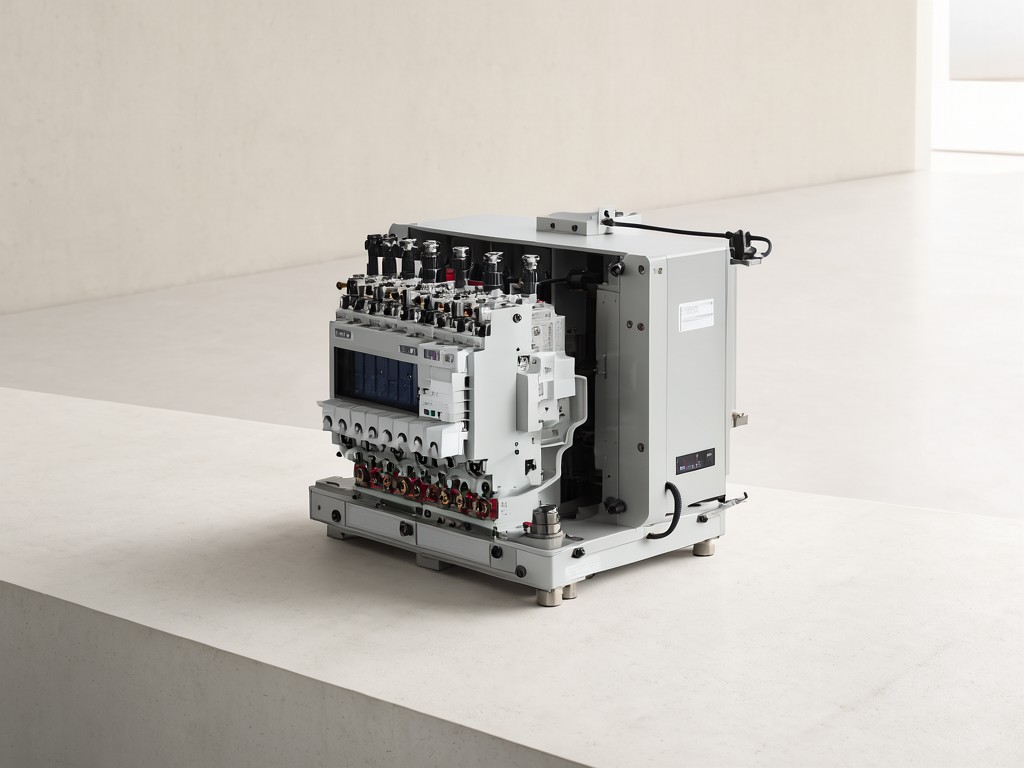
The frame is a welded 40×40×3 mm 304 stainless steel box-section, stress-relieved at 600 °C before machining. This eliminates the 0.3 mm/m distortion that appears in cold-formed sheet metal after the first thermal cycle from the 200 °C vacuum bake-out. Linear rails (THK HSR25) carry the moving electrode assembly with 5 µm straightness over 500 mm travel — critical for repeatable contact force profiles.
Cable routing uses segregated trays: 50 Ω coaxial for MAC sensor, twisted-pair shielded for micro-ohmmeter, and high-current 25 mm² for test current up to 3,150 A. Cross-talk stays below -80 dB at 1 MHz. A single-point star ground at the chassis base prevents ground loops that corrupt the 0.1 ms timing measurement.
- Frame weldment → stress relief → CNC machining (datum A: base plane, datum B: rail mounting face)
- Rail installation → laser alignment → epoxy shim (Loctite EA 9466) for 5 µm parallelism
- Vacuum chamber assembly in ISO Class 7 clean room → helium leak test < 1×10⁻⁹ mbar·L/s
- Electronics integration → 72-hour burn-in at 45 °C / 85 % RH → calibration against NIST-traceable standards
Tooling amortisation decides the price break: a dedicated fixture set for one breaker frame size costs $18–22 k and pays back at 120 units/year. Universal adjustable fixtures save tooling but add 15 % cycle time and 8 µΩ measurement uncertainty from contact misalignment.
Where This Product Beats Standard Alternatives
Off-the-shelf test sets from European vendors ship with fixed 12 kV / 25 kA ratings. Re-rating to 17.5 kV / 31.5 kA requires a new impulse transformer ($45 k) and type-test re-certification (6 months). Our modular impulse stage swaps in 4 hours — the transformer bolts to the same frame, the control software auto-detects the new voltage divider ratio.
| Parameter | Standard Bench (Fixed Rating) | Modular Configuration |
|---|---|---|
| Voltage Range | Single rating (12 kV or 24 kV) | 7.2–36 kV via plug-in divider |
| Current Range | Up to 25 kA | Up to 40 kA with parallel thyristor stacks |
| Re-rating Lead Time | 6 months + type test | 4 hours + routine calibration |
| Footprint | 2.2 × 1.8 m | 1.6 × 1.4 m (base) + 0.6 m per impulse module |
Total cost of ownership shifts once returns are counted. A fixed-rating bench returned for re-rating incurs $18 k freight, $45 k hardware, and 6 months lost production. The modular version adds $7 k upfront but eliminates all three.
Buying Mistakes That Lead to Returns
Cheaper stock options fail at the worst point in the season — usually during the Q4 type-test rush when ambient humidity hits 80 % and the MAC sensor drifts 0.05 Pa/°C. The root cause is conformal coating thickness: 25 µm acrylic passes IEC 60068-2-30 but delaminates at the sensor header after 14 thermal cycles. We specify 75 µm parylene-C applied by CVD; cost delta is $320 per unit, failure rate drops from 12 % to 0.3 % over 3 years.
Another return driver: undersized test current busbars. A 25 kA bench with 120 mm² copper bars hits 115 °C at continuous rating, annealing the contact springs in the breaker under test. Minimum 200 mm² for 25 kA, 300 mm² for 31.5 kA, 400 mm² for 40 kA — verified by IR thermography at factory acceptance.
Decision Tree — Fixture Selection:
- Breaker contact material?
- CuCr → BeCu tips (standard)
- CuW / WCu → Tungsten-carbide coated tips
- AgW → Silver-plated BeCu (prevents sulfidation)
- Test current > 25 kA?
- Yes → Water-cooled fixture rails + 300 mm² busbars
- No → Air-cooled rails, 200 mm² busbars
- Throughput > 20 units/day?
- Yes → Pneumatic quick-change fixture (15 s swap)
- No → Manual clamp fixture (90 s swap, $4 k savings)
Size and Weight Range
| Configuration | Dimensions (L×W×H, mm) | Weight (kg) | Max Test Current | Crate Size for Export |
|---|---|---|---|---|
| Base Unit (7.2–17.5 kV) | 1600 × 1400 × 1950 | 1,850 | 25 kA | 1800 × 1600 × 2150 |
| + Impulse Module (24–36 kV) | +600 mm length | +420 | 31.5 kA | 2400 × 1600 × 2150 |
| + High-Current Stack (40 kA) | +400 mm width | +680 | 40 kA | 2400 × 2000 × 2150 |
Ready to Review Your Specification?
Send us your breaker nameplate data, annual test volume, and the IEC/IEEE standard edition you certify to. We return a marked-up datasheet with fixture recommendations, re-rating path, and a firm delivery schedule within 48 hours.
Request Specification Review