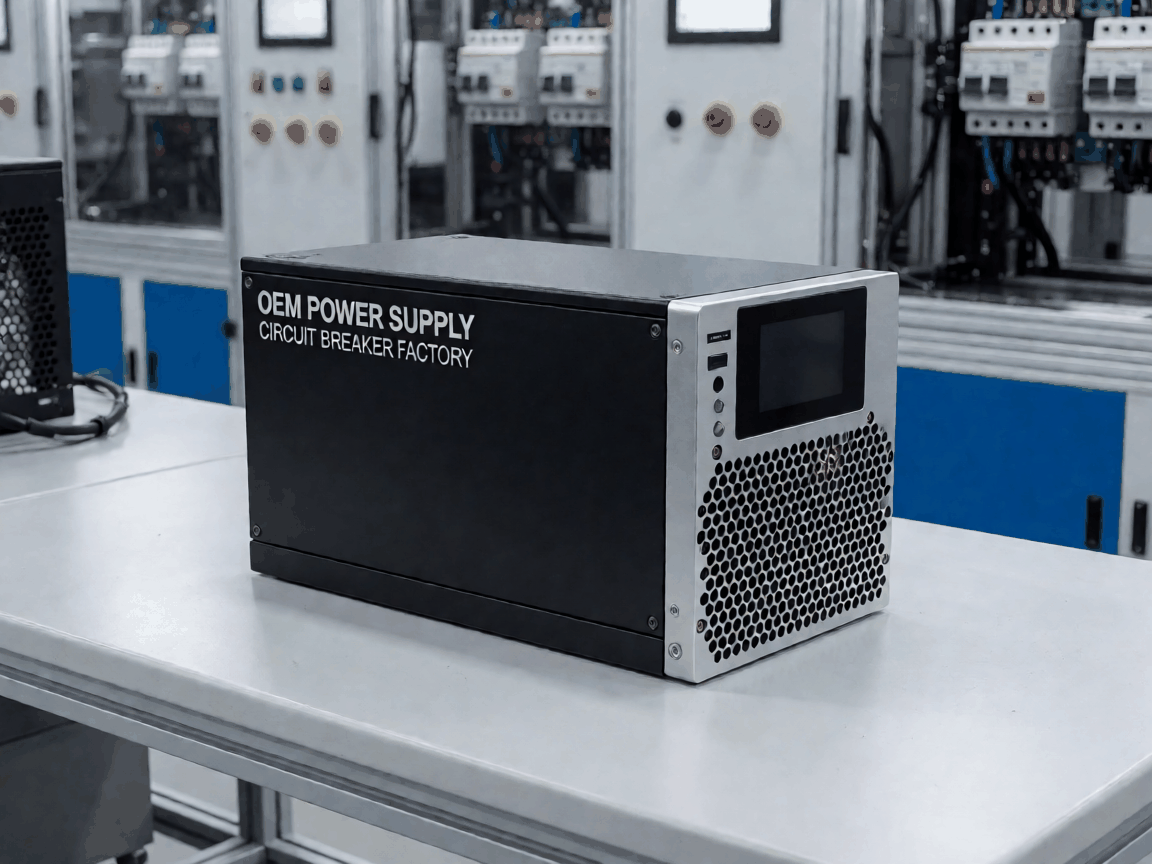
oem power supply unit for circuit breaker factory: What Buyers Should Check Before Ordering
The main trade-off sits between hold-up time at full load and electrolyte life at the rated ambient. A unit spec'd for 20 ms hold-up at 50 °C typically sacrifices capacitor headroom, which shows up as drift in output voltage after 18-24 months of continuous duty. Buyers who need five-year MTBF without derating should specify 105 °C rated capacitors and a 30 ms minimum hold-up, even if the unit costs 12-15 % more per piece.
Where Cheaper Alternatives Fall Short
Balance and load analysis shows that budget PSUs for breaker-panel integration cut cost in three places: the primary-side EMI filter, the output capacitor bank, and the thermal interface between the MOSFETs and the chassis. The filter omission passes conducted emissions testing at 230 VAC but fails at 110 VAC, which matters for factories exporting to North America. The reduced capacitor bank drops hold-up from 30 ms to 16 ms — enough for a breaker trip coil but not for the control logic that must stay alive through the same event. The thermal interface uses a 0.5 mm silicone pad instead of a 1.5 mm phase-change material, adding 8-10 °C to junction temperature at 80 % load.
Those choices compound. A 10 °C rise halves electrolytic life, so a unit rated for 50,000 hours at 40 °C ambient delivers 25,000 hours in a panel that runs 50 °C. The buyer sees random voltage drift, nuisance trips, and field returns that cost more than the per-unit savings within the first warranty cycle.
What Actually Determines Performance
Consistency depends on the transformer winding process and the secondary rectifier selection. A split-bobbin winding with triple-insulated wire keeps leakage inductance below 3 %, which limits voltage overshoot during the breaker's inductive kickback. Schottky rectifiers on the 12 V and 24 V rails reduce forward drop by 0.3 V compared to silicon diodes, recovering 2-3 W of loss that otherwise heats the enclosure. The PWM controller's soft-start ramp — typically 8-12 ms — prevents inrush current from tripping the upstream MCB during cold start.
The interface between parts determines whether the unit survives vibration. Through-hole capacitors need a clinch-and-stake operation; surface-mount MLCCs need a conformal coat that bridges the termination to the board. Factories that skip the stake step see capacitor leads fatigue at the solder joint after 6-9 months of panel vibration from breaker operations. We run a 10 g, 10-500 Hz sweep for two hours per axis on every lot, not just first article.
Where This Product Beats Standard Alternatives
The output voltage stays within ±1.5 % from no-load to full-load across -25 °C to +70 °C without derating. That tolerance comes from a voltage-mode controller with feed-forward compensation, not from post-regulation linear stages that waste power. Ripple and noise measure 50 mVpk-pk on the 24 V rail at 20 MHz bandwidth — half the typical spec — because the output filter uses a two-stage LC with a 4.7 µH powdered-iron choke and 1000 µF of 105 °C polymer capacitors.
MTBF calculated per Telcordia SR-332 Issue 3 at 40 °C ground benign exceeds 500,000 hours. The design margin shows in the derating curves: at 70 °C ambient the unit delivers 85 % rated power without fan assist, whereas competing units drop to 60 % or require forced air that adds a failure point.
| Stress Factor | Test Method | Acceptance Criterion | Typical Failure Mode If Skipped |
|---|---|---|---|
| Capacitor electrolyte life | 1000 h at 105 °C, rated ripple current | ESR increase < 20 %, capacitance loss < 15 % | Output voltage drift, increased ripple, thermal runaway |
| Solder joint fatigue | Vibration 10 g, 10-500 Hz, 2 h/axis | No open/short, output within spec | Intermittent output, nuisance breaker trips |
| Thermal cycling | -40 °C to +85 °C, 100 cycles, 15 min dwell | No parameter shift > 5 % | Cracked ferrite cores, delaminated PCB |
| Hi-pot isolation | 3 kVAC primary-to-secondary, 1 min | Leakage current < 5 mA | Insulation breakdown, safety hazard |
| Conducted EMI | CISPR 22 Class B, 150 kHz-30 MHz | 6 dB margin at worst case | Failed certification, field interference |
Customisation Options and Their Limits
Output voltage can be set between 12 V and 48 V in 1 V steps by changing the feedback divider resistors — a zero-tool-change that adds one day to lead time. Current limit foldback profile is programmable via an external resistor on the CC pin, allowing the buyer to match the trip-coil inrush characteristic without hardware revision. The enclosure mounting pattern follows DIN 43880; alternative hole patterns require a stamping die (4-6 weeks, $800-$1,200) and a minimum order of 500 units to amortise.
Conformal coating options: acrylic (standard, 25 µm), urethane (chemical resistance, 50 µm), or parylene (maximum coverage, 15 µm, +$0.80/unit, +3 days). Parylene is the only choice if the panel sees condensing humidity or salt fog; acrylic passes IEC 60068-2-30 but fails after 500 h salt spray. Private-label silkscreen uses a two-colour pad print; artwork must be vector, 300 dpi minimum, with 0.5 mm clearance from vent holes.
Usage Scenarios and Buyer Segments
Panel builders supplying medium-voltage switchgear to utilities specify the 24 V/10 A model with parylene coating and 30 ms hold-up. Their panels sit in unconditioned substations where ambient hits 60 °C and humidity cycles daily. The 500,000-hour MTBF aligns with the utility's 20-year asset plan, and the 6 dB EMI margin prevents re-certification when the panel ships to a different grid code.
OEMs of motor-control centres choose the 12 V/5 A version with acrylic coating and standard hold-up. Their panels are indoor, climate-controlled, and the 12 V rail powers only PLC I/O and indication lamps. They accept the 16 ms hold-up because the PLC has its own super-cap backup. Unit cost is 18 % lower, and the 250-unit monthly forecast fits the standard packaging reel.
Distributors stocking for aftermarket breaker retrofits order the 48 V/3 A model with DIN-rail clip and screw-terminal block. The 48 V rail matches legacy trip units; the clip allows tool-less swap in live panels. They need 50-unit MOQ per variant, blank label for their brand, and a 30-day shelf-life guarantee on the electrolytic formation date.
Volume Planning and Lead Time
Standard models (12 V/5 A, 24 V/5 A, 24 V/10 A, 48 V/3 A) ship from finished-goods buffer at 200 units per week per variant. Custom voltage or coating adds 10 working days; custom enclosure tooling adds 30 working days after first-article approval. The critical path is the transformer — wound in-house, but core material has a 12-week lead from the mill. We keep safety stock for 8 weeks of forecasted demand; beyond that, the buyer's rolling forecast locks the allocation.
Packaging: anti-static trays of 20 units, vacuum-sealed with desiccant and humidity indicator card. Master carton holds 5 trays (100 units), 380 × 280 × 220 mm, 14 kg gross. Pallet configuration: 24 cartons per Euro pallet, stretch-wrapped, corner boards, tip-and-tell indicator. Export shipments get ISPM-15 stamped pallets and a Certificate of Conformance per lot.
Ordering, Tooling and Lead-Time Questions
What is the minimum order for a custom output voltage?
50 units. The resistor change is a BOM line swap, not a PCB respin, so no NRE. First article ships in 10 working days after PO.
Can we qualify a second source for the transformer core?
Yes, but the winding machine program is tuned to the specific core grade (PC47 or equivalent). A core change requires re-characterisation of leakage inductance and saturation current — add 15 working days and 30 pilot units for validation.
How is lot traceability maintained?
Each unit carries a 2D data-matrix code linking to the build record: transformer batch, capacitor date codes, firmware revision, hi-pot result, and burn-in log. The master carton label duplicates the lot ID. Records are retained for 7 years.
What happens if a field return shows capacitor venting?
We issue an 8D report within 10 business days. If root cause traces to a capacitor lot, we quarantine all units from that lot code — typically 2,000-5,000 pieces — and replace at no cost. The buyer receives a disposition list by serial number within 48 hours.
Request a Quotation Review
Send your panel specification, annual volume, and target unit cost. We return a marked-up datasheet showing which options meet your MTBF and EMI requirements at the lowest landed cost, plus a first-article schedule.
Start Quotation Review