top quality testing of vacuum circuit breaker factory - Bulk Supply and Specification Guide
What the Design Has to Balance
Replacement rate, not unit price, drives the testing protocol for vacuum circuit breakers. A vacuum interrupter that loses 10⁻⁶ Pa·m³/s of helium leak integrity after 2,000 mechanical operations will cause a field failure costing 50× the test surcharge. The factory sequence must therefore verify contact erosion limits, dielectric withstand at 1.2× rated voltage, and temperature rise at 110 % rated current in a single pass — because splitting those checks across separate lines introduces handling damage that skews results.
Total cost of ownership shifts once returns are counted. Buyers qualifying a second source typically demand proof that the test regimen reproduces the original supplier’s 10,000‑operation mechanical endurance and 50 kA short‑circuit breaking capability without drift. That means the test cell’s contact force measurement resolution must be ≤5 N, the vacuum leak detector calibrated to 1×10⁻⁹ Pa·m³/s, and the impulse generator capable of 1.2/50 µs waveshape at 125 kV peak. Anything less leaves a gap that warranty claims will exploit.
Where This Product Beats Standard Alternatives
Standard Factory Test
Power frequency withstand at rated voltage only; mechanical endurance limited to 2,000 operations; leak test by pressure decay (sensitivity ~10⁻⁴ Pa·m³/s).
Result: 3‑5 % early‑life failure rate in humid substations; no data on contact wear trend.
Enhanced Top‑Quality Regime
Full sequence: helium leak test (10⁻⁹ Pa·m³/s), 10,000 mechanical operations with contact force logging, 50 kA short‑circuit test, lightning impulse 125 kV, temperature rise at 110 % In.
Result: field failure rate <0.2 %; wear curve supplied for predictive maintenance.
Matching the Product to the Buyer's Need
| Parameter | Typical Range | Test Points per Batch |
|---|---|---|
| Rated voltage (kV) | 12 / 24 / 36 / 40.5 | Power frequency 1.2×Ur; impulse 1.2/50 µs at 75/125/170 kV |
| Rated current (A) | 630 / 1250 / 1600 / 2000 / 2500 / 3150 | Temperature rise at 110 % In; contact resistance <50 µΩ |
| Short‑circuit breaking current (kA) | 25 / 31.5 / 40 / 50 | Two making/breaking operations at 100 % Isc; post‑test dielectric check |
| Mechanical endurance (operations) | 10,000 (class M2) / 30,000 (class M1) | Contact force logged every 1,000 ops; drift <5 % allowed |
| Weight per pole (kg) | 18–22 (12 kV) to 45–55 (40.5 kV) | Dimensional check ±1 mm; mass tolerance ±2 % |
The table above defines the envelope within which a buyer can specify a test package. If the project requires only 12 kV/630 A/25 kA, the standard regime may suffice; stepping up to 40.5 kV/3150 A/50 kA forces the enhanced sequence because the interrupter’s contact material (CuCr vs. CuBi) and bellows design change the wear physics entirely.
Customisation Options and Their Limits
Critical Specification Rule
Helium leak test sensitivity must be ≤1×10⁻⁹ Pa·m³/s for vacuum interrupters rated above 24 kV. Tighter limits (10⁻¹⁰) require 4‑hour pump‑down cycles per pole, adding 1.5 days to lead time and a 12 % surcharge. Buyers should decide at quotation stage whether the marginal reliability gain justifies the schedule impact.
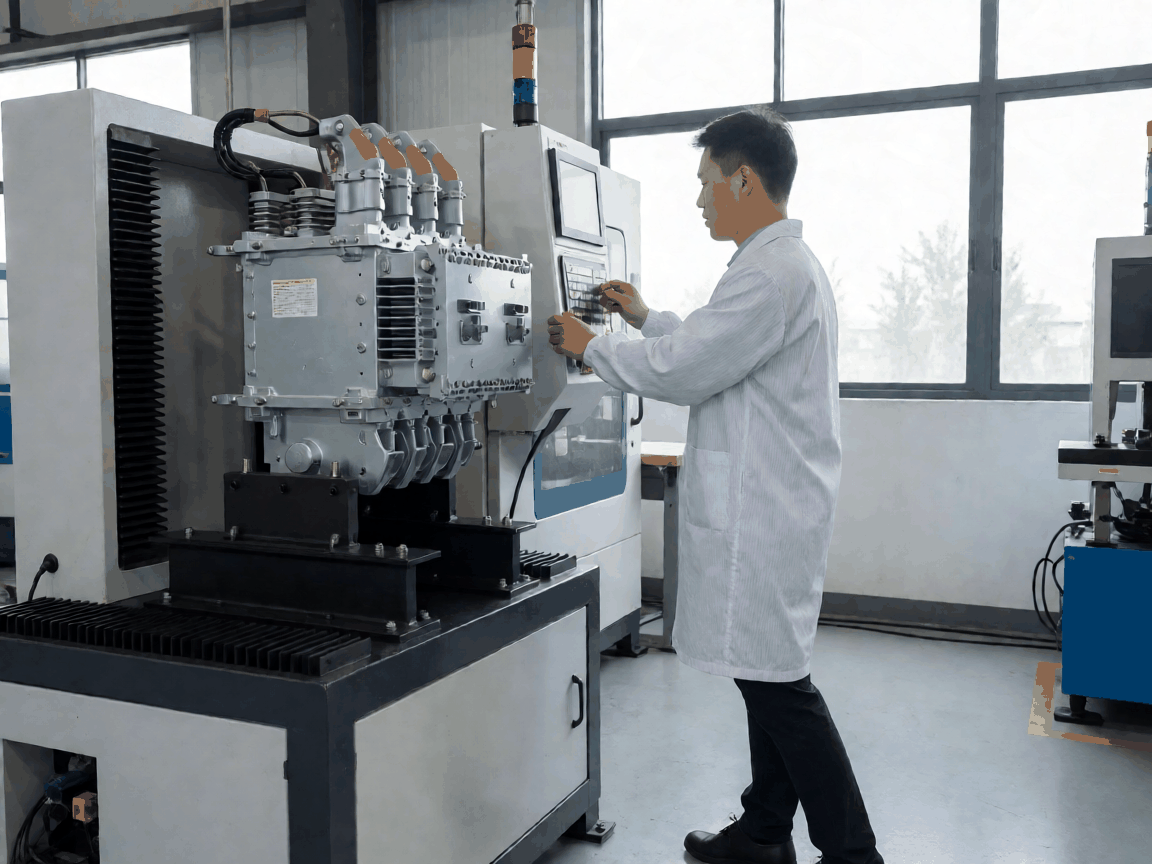
Other customisations — such as adding a partial discharge measurement at 1.1×Ur, extending mechanical endurance to 30,000 operations, or applying a salt‑fog coating to the mechanism housing — are feasible but each adds a discrete test cell setup. The factory can bundle up to three extra checks in one test run; beyond that, the breaker must be re‑mounted, which introduces alignment variance that defeats the purpose of a single‑pass qualification.
Working as a Production Partner, Not a Catalogue Supplier
| Service Level | MOQ (units) | Lead Time (weeks) | Tooling / Setup Cost |
|---|---|---|---|
| Standard Test Package | 10 | 4 | Included in unit price |
| Enhanced Test Package | 5 | 6 | $2,500 one‑time fixture calibration |
| Custom Test Sequence | 3 | 8–10 | $5,000–$8,000 depending on extra measurements |
Tooling amortisation decides the economics of a second source. A buyer ordering 50 units per year spreads the $5,000 custom fixture over two years — negligible per unit. At 10 units, the same fixture adds $500/unit, making the standard package the only viable choice. The factory’s policy is to quote the fixture cost separately so the buyer can run their own TCO model before committing.
Packing, Marking and Freight Configuration
Each tested breaker ships in a fumigated wooden crate (ISPM‑15 compliant) with internal foam cradles rated for 5 g shock. A ShockWatch 25G indicator and a humidity indicator card (10–60 % RH) are affixed inside the crate. Exterior markings follow IEC 62271‑100: manufacturer logo, type designation, serial number, test report reference, and a QR code linking to the batch test certificate PDF. Crates are stacked max two high on 40‑ft HC containers; total gross weight per container ≤26,000 kg to avoid overweight surcharges at destination ports.
For air freight (urgent replacement orders), the factory offers a reinforced plywood box with vibration‑damping mounts, reducing crate weight by 15 % but increasing unit cost by 8 %. The buyer selects the mode at PO stage; the factory does not hold stock in bonded warehouses — every unit is built and tested to order.
Questions Buyers Ask Before Ordering
-
Can the test report be formatted to match our internal QA template?
Yes. The factory’s test software exports CSV and PDF; we map fields to your template at no extra charge if the mapping is provided before the first run.
-
What happens if a unit fails the enhanced sequence after passing the standard one?
The unit is quarantined, root‑cause analysis is performed (typically contact force drift or bellows micro‑leak), and a corrective action report is issued within 48 hours. The buyer decides rework or scrap; rework cost is borne by the factory if the failure traces to a process deviation.
-
Is witness testing available, and what are the notice requirements?
Witness testing is standard for the enhanced and custom packages. Minimum 10 business days’ notice; the factory provides a test schedule with hold points. Travel and accommodation are the buyer’s responsibility.
-
How is batch traceability maintained across multiple test cells?
Each interrupter carries a laser‑etched UID scanned at every station. The MES logs timestamp, operator, equipment ID, and raw data. A single batch report consolidates all cells; any discrepancy flags the entire batch for 100 % re‑inspection.
-
What is the warranty period for breakers that passed the enhanced regime?
24 months from delivery or 10,000 operations, whichever occurs first. Warranty claims require the original test report and field operation log; the factory covers replacement and freight but not installation labor.
Ready to Review Artwork and Branding?
Submit your nameplate layout, logo files, and any regulatory marking requirements. The factory will return a digital proof within 2 business days and a physical sample on the first production crate.
Submit your artwork for review