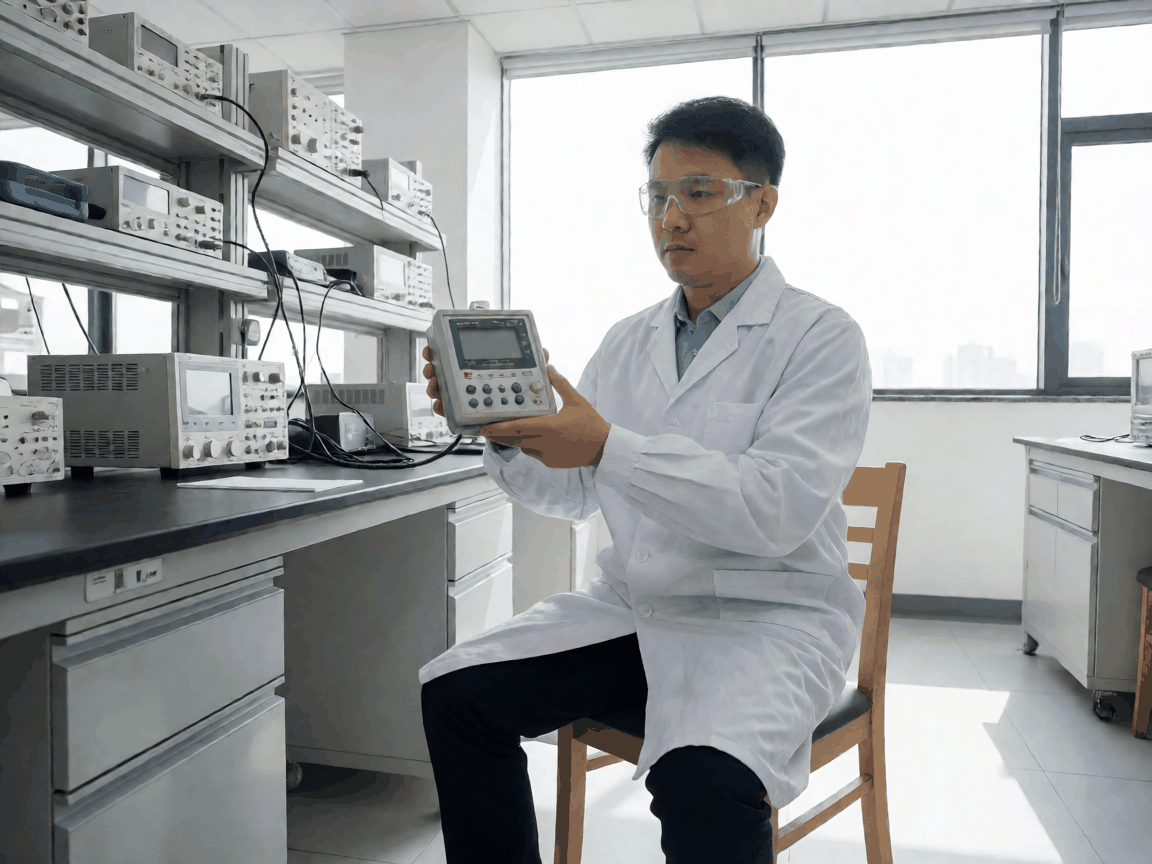
Specifying china digital earth ground resistance tester suppliers for Wholesale and OEM Orders
Design Constraints Behind the Specification
Material choice starts with the conditions the product will meet. A digital earth ground resistance tester lives in the hands of utility crews, electrical contractors, and maintenance teams who work in substations, construction sites, and remote telecom towers. The housing must survive repeated drops onto concrete, resist solvent wipes used for decontamination, and maintain its IP67 seal after thousands of battery-door cycles. Internally, the ASIC and front-end amplifier set the noise floor; a 0.01 Ω resolution on a 20 Ω range demands a 24-bit delta-sigma converter with a calibrated reference that does not drift more than 50 ppm/°C across -10 °C to 50 °C.
The test-current waveform is equally constrained. IEC 61557-5 requires a 128 Hz square wave (or 125 Hz in some regions) with a current magnitude that does not exceed 20 mA rms on the 200 Ω range, yet must deliver enough signal-to-noise to reject 50/60 Hz mains interference up to 40 V. That forces a trade-off between the H-bridge driver’s on-resistance, the battery’s internal impedance at end-of-life, and the firmware’s adaptive filtering window. If any of these parameters shift between production lots, the unit fails type-test verification and the whole batch is held.
Critical spec rule: Every shipment must include a factory calibration certificate traceable to a national metrology institute, showing actual measured error at 0.1 Ω, 1 Ω, 10 Ω, and 100 Ω points. Without it, the buyer’s incoming QC will reject the lot, and the supplier bears return freight.
Material Options and Their Trade-offs
Construction options diverge as soon as weight matters. The three mainstream housing approaches are summarized below.
ABS + Rubber Overmold
Lowest tooling cost; two-shot mould adds ~0.15 kg. Good impact absorption but the overmold can delaminate after 2 years of UV exposure.
Best for price-sensitive private-label programmes where units are replaced on a 3‑year cycle.
Polycarbonate/ABS Blend (PC/ABS)
Single-shot mould, 10 % lighter than overmolded ABS. Inherent UV stability; passes 1 000 h QUV without chalking. Higher resin cost adds ~$1.20/unit at 5 k volume.
Preferred for OEM brands that warranty 5 years and need consistent colour match across annual reorders.
Test leads are a separate materials decision. Silicone-insulated, 4 mm banana plugs with gold-plated contacts survive 10 k flex cycles at -20 °C; PVC leads stiffen and crack below 0 °C, causing intermittent readings that show up as “noise” in the field. The $0.80/lead premium for silicone pays back in reduced warranty claims within the first 500 units shipped.
Where This Product Beats Standard Alternatives
Where high electrical noise and harsh field conditions are routine, the four-wire Kelvin measurement with automatic frequency selection (94 Hz, 105 Hz, 111 Hz, 128 Hz) eliminates the need for manual frequency hopping. Competing three-wire models require the operator to disconnect the earth electrode, adding 5–10 minutes per test point and introducing connection-resistance errors that can exceed 0.5 Ω on corroded stakes.
| Parameter | Typical Range / Value | Test Condition / Note |
|---|---|---|
| Measurement Range | 0.01 Ω – 2 kΩ (auto-ranging) | Four ranges: 0.2 Ω, 2 Ω, 20 Ω, 200 Ω, 2 kΩ |
| Basic Accuracy | ±(1.5 % rdg + 0.02 Ω) | At 23 ± 5 °C, <80 % RH, after 30 min warm-up |
| Test Current (max) | 20 mA rms (200 Ω range) | Limited by IEC 61557-5; lower on higher ranges |
| Display | 4.3″ transflective TFT, 480×272, LED backlight | Readable in direct sunlight; backlight auto-off after 30 s |
| Data Logging | 10 000 records, timestamped, CSV export via USB-C | Optional Bluetooth 5.0 module for mobile app sync |
| Safety Rating | CAT IV 600 V / CAT III 1000 V | Per IEC 61010-1; verified by third-party lab |
| Environmental | IP67, -20 °C to 55 °C operating | Tested 1 m submersion for 30 min; drop 1.2 m on concrete |
| Power | 4× AA alkaline or NiMH; 20 h continuous | Low-battery warning at 4.8 V; auto-power-off configurable |
The transflective TFT is a deliberate cost/performance decision. A monochrome segment LCD would save $3.50/unit but cannot display the real-time noise-level bar graph that lets an operator verify lead integrity before recording a reading. That graph alone cuts repeat visits by an estimated 12 % on high-resistance soils.
Buying Mistakes That Lead to Returns
The most expensive mistake is specifying a “basic” model without the automatic frequency selection, then discovering that the utility’s specification mandates multi-frequency testing for cathodic protection systems. The buyer then faces a full recall and re‑order at premium lead time.
Second is accepting a supplier’s “standard” calibration certificate that only shows a single-point check at 10 Ω. Field auditors increasingly demand multi-point traceability; a missing 0.1 Ω data point triggers a non-conformance report that stops payment.
Third is overlooking the battery-door latch design. A snap-fit latch moulded in the same PC/ABS as the housing fatigues after ~200 cycles; a stainless-steel torsion spring latch adds $0.35 but survives 2 000 cycles. The latter is mandatory for rental fleets where units see daily battery swaps.
Procurement checkpoint: Require a first-article inspection report that includes drop test (1.2 m, 6 faces), IP67 immersion, and a full 5-point calibration across all ranges. Approve the report before the supplier releases the production run.
Capacity, Tooling and Scheduling
The PC/ABS housing uses a four-cavity family mould that produces the main body, battery door, and terminal cover in a single cycle. At 45 s cycle time, the cell delivers 320 housings/hour. With two shifts, the monthly capacity is 46 k units; the bottleneck is the automated calibration station, which handles 1 200 units/day. That station also burns in the firmware and logs the calibration coefficients to the unit’s serial EEPROM, so every shipped tester carries its own traceability record.
Lead time for a new private-label colour (Pantone-matched) is 6 weeks: 3 weeks for colour chip approval, 2 weeks for masterbatch qualification, 1 week for first-article mould trial. Standard grey (RAL 7035) is stocked as semi-finished assemblies, allowing a 10‑day turnaround for orders up to 2 k units.
| Packaging Configuration | Units per Carton | Carton Dimensions (mm) | Gross Weight (kg) | Notes |
|---|---|---|---|---|
| Standard OEM carry case (EVA foam, custom logo) | 5 | 420 × 310 × 210 | 6.8 | Includes 4 test leads, 2 stakes, USB-C cable, calibration cert |
| Bulk pack (anti-static bags, master carton) | 20 | 560 × 380 × 280 | 14.2 | For distributors who re-package; leads coiled separately |
| Retail blister (clamshell, hang-tag) | 12 | 480 × 340 × 320 | 9.5 | Meets EU shelf-ready requirements; barcode on tag |
All cartons are double-wall corrugated (ECT 48) with corner protectors. Palletisation is 48 cartons per Euro pallet (1200×800 mm), stretch-wrapped with 23 µm film and strapped. This configuration survives the 1.5 g vibration profile of ocean freight without case cracking.
Ready to Review Tooling and Calibration Flow?
We can share the mould layout, calibration station SOP, and a sample first-article report for your quality team. Minimum order for custom housing colour is 1 000 units; standard grey is available from 200 units with 10‑day lead time.
Request Tooling Review & Sample Allocation