Specifying china earth electrode grounding impedance tester factory for Wholesale and OEM Orders
What This Product Is and Where It Fits
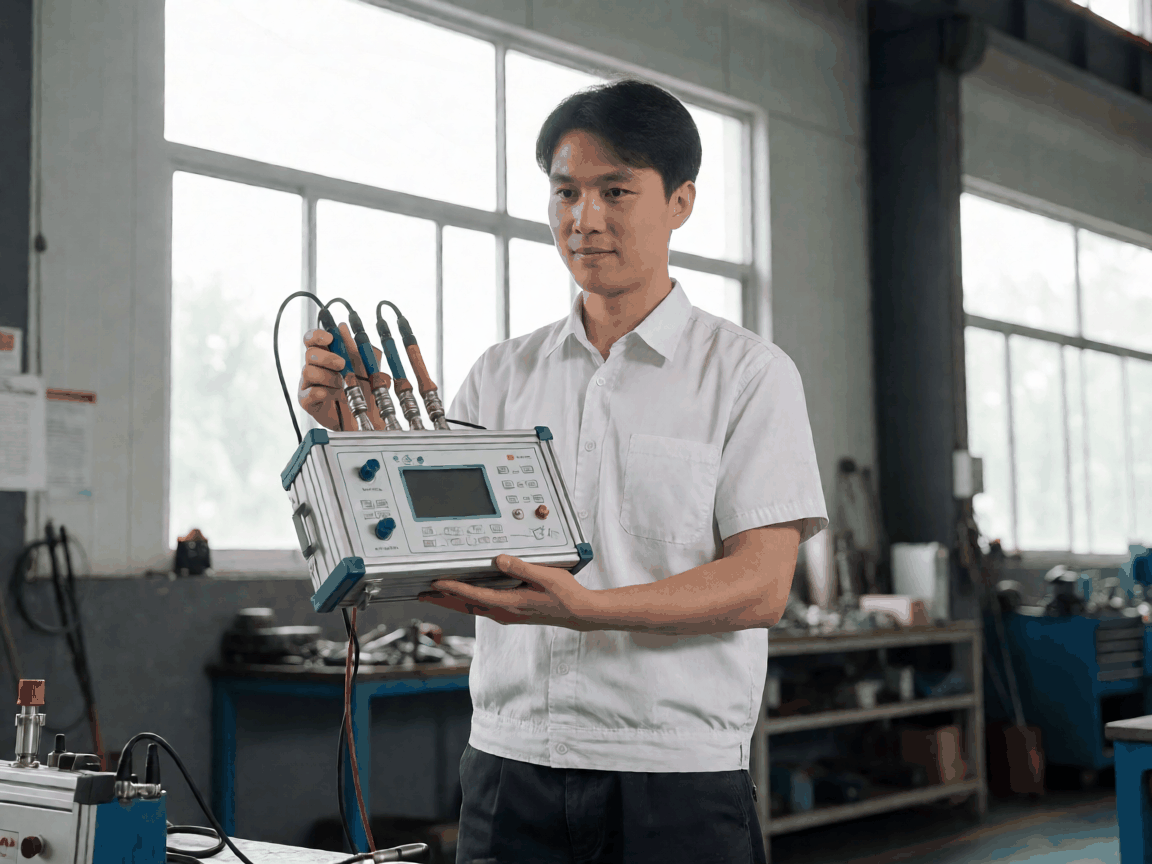
Returns usually trace back to the same weak point: a tester that passes bench calibration but drifts once it rides in a service truck through monsoon season or sits on a substation rack for eighteen months. The instruments we build are three- and four-pole ground resistance meters with selectable test frequencies (94 Hz, 105 Hz, 128 Hz, 1367 Hz) and a clamp-on option for loop impedance without driving auxiliary stakes. They target electrical contractors maintaining utility substations, industrial plant grounding grids, telecom tower earthing, and lightning protection systems — anywhere a failed ground path means equipment damage or safety violations.
Buyers qualify a second source when their current supplier cannot hold ±2 % accuracy across the full 0.01 Ω–20 kΩ range after a year of field abuse, or when lead times stretch past eight weeks because the factory runs a single PCB assembly line. Our line separates the analog front-end (AFEM) from the digital controller, so a firmware update or a calibration coefficient change never requires a board respin. That architectural decision is what keeps reorder rates above 85 % for distributors who stock twenty to fifty units per SKU.
Material Options and Their Trade-offs
The housing choice drives three field complaints: cracked corners from drops, terminal corrosion in coastal humidities, and display fogging after rapid temperature swings. We offer two grades:
Standard ABS/PC Blend
Glass-filled 15 % ABS/polycarbonate, UL 94 V-0. Survives 1 m drop onto concrete at −10 °C to 50 °C. Terminals are nickel-plated brass with O-ring seals. Cost baseline.
Weakness: prolonged UV exposure yellows the bezel after 18–24 months; salt spray (ASTM B117, 96 h) shows light terminal oxidation.
Ruggedised PBT/PC Alloy
30 % glass-filled PBT/polycarbonate, UV-stabilised, UL 94 5VA. Terminals are gold-flash over nickel on beryllium copper. Double-gasket display window. Adds 12 % unit cost.
Eliminates the three complaint modes above. Chosen by utilities specifying 7-year field life and by rental fleets turning inventory every 14 months.
Specification rule: If the tender requires IEC 61010-1 CAT IV 600 V / CAT III 1000 V, the ruggedised housing is mandatory — the standard blend only carries CAT III 600 V. The price delta is recovered in fewer warranty returns within the first calibration cycle.
Size, Weight and Specification Range
Most quality disputes start with a consistency gap: the datasheet says 0.001 Ω resolution but the production spread is 0.003 Ω because the reference resistor network isn't trimmed per unit. We laser-trim each AFEM board at final test, then store the coefficients in EEPROM. The table below reflects post-trim limits, not design targets.
| Parameter | Standard Model | Advanced Model (Clamp + Stake) |
|---|---|---|
| Measurement range (Ω) | 0.01 – 20 k (3-pole), 0.01 – 50 k (4-pole) | 0.005 – 20 k (stake), 0.01 – 1.5 k (clamp) |
| Basic accuracy | ±(1.5 % + 0.01 Ω) | ±(1.0 % + 0.005 Ω) stake / ±(2.0 % + 0.01 Ω) clamp |
| Test frequency | 94 / 105 / 128 Hz selectable | 94 / 105 / 128 / 1367 Hz + auto-frequency scan |
| Test current (max) | 50 mA rms | 200 mA rms (stake), 1 A rms (clamp) |
| Noise rejection | > 40 dB at 50/60 Hz | > 60 dB at 50/60 Hz, adaptive FFT filter |
| Display | 128×64 transflective LCD, backlit | 320×240 colour TFT, sunlight readable |
| Data logging | 999 records, USB-C export | 10 000 records, Bluetooth + USB-C, PDF/CSV |
| Battery (field replaceable) | 4 × AA alkaline, 2000 tests | Li-ion pack (7.4 V, 5 Ah), 1500 tests, USB-PD charge |
| IP rating | IP54 | IP65 |
| Weight (with batteries) | 1.1 kg | 1.6 kg |
| Dimensions (L×W×H) | 220 × 110 × 55 mm | 260 × 130 × 65 mm |
Option Comparison by Usage Level
Wear shows up at the same point every season: the stake cable jacket cracks at the strain relief after 300–400 insertions, and the clamp jaw alignment shifts enough to add 0.02 Ω systematic error. The comparison block below maps configuration to the actual maintenance interval buyers experience.
Contractor Daily Use
- Standard model, ruggedised housing
- Silicone-jacketed stake cables (custom tooling)
- Reinforced strain relief moulded 30 mm longer
- Calibration interval: 12 months
- Expected cable replacement: 18 months
Utility / Rental Fleet
- Advanced model, ruggedised housing
- Clamp with self-aligning cam mechanism
- Keypad membrane rated 1 M cycles
- Calibration interval: 6 months (traceable cert)
- Expected clamp realignment: 24 months
What Can Be Customised and What Cannot
Private-label buyers need to know the hard limits before artwork approval. The AFEM board, test frequencies, and safety clearances are fixed — they define the CAT rating and IEC 61557 compliance. What moves:
- Boot screen logo (128×64 or 320×240 BMP, 1-bit or 24-bit)
- Case colour (Pantone-matched ABS/PC or PBT/PC, MOQ 500 pcs per colour)
- Language pack (up to 5 languages in firmware, selectable at first boot)
- Carry case foam insert profile (CAD file required, adds 2 weeks tooling)
- Calibration certificate format (your logo, your accreditation number, QR code to your portal)
What does not move: input protection topology, creepage/clearance distances, battery chemistry (alkaline vs Li-ion is a model choice, not a per-order option), and the test lead pin diameter (4 mm banana, fixed by IEC 61010). Attempting to change these triggers a new type test — 14 weeks and €18 k–25 k.
What Gets Checked Before Shipment
Every unit passes a 14-station automated test sequence before it reaches the packing bench. The stations that catch the field complaints:
| Station | Check | Pass Criterion | Failure Mode Prevented |
|---|---|---|---|
| S1: Reference resistor sweep | 0.01 Ω, 0.1 Ω, 1 Ω, 10 Ω, 100 Ω, 1 kΩ, 10 kΩ | All points within ±1.0 % of nominal | Calibration drift from untrimmed gain |
| S3: 50/60 Hz injection | 10 V rms common-mode on current leads | Reading shift < 0.5 % | Noisy substation readings |
| S5: Clamp jaw closure force | Spring force at 25 mm jaw opening | 18–22 N | Clamp reading offset from poor contact |
| S7: Thermal shock | −20 °C ↔ +60 °C, 5 cycles, 30 min dwell | No condensation, accuracy held | Display fogging, seal failure |
| S10: Drop test (sample) | 1 m onto steel plate, 6 faces, 3 edges, 1 corner | Function + accuracy intact | Cracked housing, PCB delamination |
| S14: Firmware checksum | CRC-32 of application + bootloader | Matches golden image | Field brick from corrupted flash |
Failed units are segregated, root-caused, and the failure mode fed back to the SMT line AOI criteria within the same shift. That loop is why our DPPM runs under 200 for the advanced model.
Capacity, Tooling and Scheduling
Two SMT lines (one lead-free, one SnPb for legacy military SKUs) feed a single box-build cell. The AFEM board is the bottleneck — 1 200 panels/week at 98 % first-pass yield. Standard model lead time: 4 weeks ARO for 100–500 pcs, 6 weeks for 500–2 000 pcs. Advanced model adds one week for clamp calibration fixture time.
Custom case colour tooling: 3 weeks for mould modification, runs in parallel with PCB fabrication. First article inspection (FAI) report to AS9102 Form 3 available on request — adds 5 business days before mass production release. Blanket orders with quarterly releases lock pricing for 12 months; we hold 15 % safety stock of finished AFEM boards to absorb forecast bumps.
Questions Buyers Ask Before Ordering
- Can we use our own test leads? Only if they meet 4 mm banana, CAT IV 600 V, and ≤ 0.5 Ω loop resistance. We supply a validation jig for your incoming QC.
- What happens if the clamp jaw spring fatigues? The cam mechanism is field-replaceable (part #CLM-SPR-02, €12 list). Procedure: two Torx T10 screws, 3 minutes. No recalibration needed.
- Is the Bluetooth radio certified for our region? Module carries FCC ID, IC, CE-RED, RCM, MIC. We provide the DoC package; you file the final product listing.
- How do you handle calibration drift claims after 11 months? Return the unit — we re-run the S1 sweep at no charge. If drift exceeds spec, we replace the AFEM board and issue a new traceable certificate. Shipping both ways is on us for the first calibration cycle.
- Minimum order for private label? 200 pcs standard model, 100 pcs advanced model. Below that, we apply a €1 500 setup fee per SKU.
- Can the advanced model run on AA alkalines in an emergency? No — the 200 mA test current needs the Li-ion pack's low ESR. A 4×AA sled would sag below 4.5 V under load and trip the brown-out detector.
Ready to Qualify a Second Source?
Send us your spec sheet, annual volume forecast, and any customisation requirements. We return a quotation with FAI timeline, calibration certificate template, and a 3-unit evaluation kit at distributor cost within 3 business days.
Request Quotation Review