china earth ground resistance resistivity tester price: Specification, Ordering and Quality Notes
What the Design Has to Balance
| Parameter | Typical Range | Design Trade-off |
|---|---|---|
| Measurement range (resistance) | 0.01 Ω – 20 kΩ | Wider range demands higher test voltage or multi-frequency injection, increasing BOM and calibration steps |
| Measurement range (resistivity) | 0.1 Ω·m – 100 kΩ·m | Four-pole Wenner method needs precise stake spacing; longer leads add capacitance and noise |
| Basic accuracy | ±2% rdg ± 0.01 Ω | Tighter spec requires 0.1% reference resistors and temperature-compensated front-end — adds $15–25/unit |
| Test frequency | 94 Hz, 105 Hz, 111 Hz, 128 Hz (selectable) | Multi-frequency filtering rejects 50/60 Hz noise but needs DSP firmware validation per batch |
| Test current (max) | 20 mA – 250 mA | Higher current improves signal-to-noise on high-resistivity soil but stresses battery and MOSFET switches |
| Display type | Segment LCD / 3.5" TFT | TFT adds $8–12 and 30 mA draw; segment LCD survives -20 °C without heater |
| IP rating | IP54 / IP65 | IP65 needs over-moulded connector boots and gasketed battery door — tooling cost $3,000–5,000 |
| Data logging | 1,000 – 10,000 records | Flash endurance and file-system validation; adds firmware test time per unit |
Deflection under load governs the front-end architecture more than the display or logging features. A 250 mA constant-current source driving 100 m of 2.5 mm² test lead sees 1.7 Ω loop resistance; the booster must hold regulation within 1% while the MCU samples at 16-bit resolution. That power stage — MOSFET, sense resistor, and thermal pad — is where returns originate. Buyers report calibration drift after six months when the sense resistor shifts 50 ppm/°C and the thermal path to the aluminium mid-frame is interrupted by a conformal-coat void. The fix is a 0.1% 25 ppm/°C thin-film resistor and a dedicated copper pour under the FET, but that adds two SMT lines and a 100% thermal-camera inspection step.
Balance and load analysis shows the clamp-on accessory path creates a second failure mode. The Rogowski coil or Hall sensor head sees 50 A–1 kA primary current in noisy substation environments. If the coil former warps 0.3 mm during over-moulding, phase error exceeds 2° and the 3-pole fall-of-potential calculation fails IEC 61557-5 limits. We qualify coil formers at 120 °C/2 hr post-mould anneal and 100% phase-angle test at 50 Hz/100 A. That test fixture costs $12,000 and adds 45 seconds per unit — only justified when annual volume exceeds 3,000 pcs.
Specification Range and Customisation Limits
The interface between parts determines whether a private-label order ships in six weeks or sixteen. Standard catalogue models use a shared PCB platform: one main board covers 2-pole, 3-pole, and 4-pole methods with firmware-configurable relay matrices. Custom ranges — say 0.001 Ω resolution for telecom tower grounding — require a separate gain-stage daughter board. That daughter board needs its own stencil, pick-and-place program, and reflow profile validation. Tooling amortisation starts at $4,500 for the daughter-board fixture plus $2,200 per additional test frequency calibrated. Below 500 pcs the per-unit cost adder exceeds 35%; at 2,000 pcs it drops to 9%.
Enclosure colour and branding are the simplest changes — pad-print or UV-ink on the ABS/PC blend bezel — but the membrane keypad legend requires a new laser-etch fixture ($800) and a 500-piece MOQ from the keypad supplier. Display language packs live in a 4 MB SPI flash; adding a language costs two engineer-days for font verification and a one-time $300 flash-programming jig update. Buyers who need NIST-traceable calibration certificates should budget $85/unit for the 17025-accredited lab pass-through; we batch certificates quarterly to keep logistics cost under $12/unit.
Standard Platform (Catalogue)
- Shared main PCB, 3 test frequencies
- Segment LCD, IP54
- 1,000-record logging, USB-C
- Lead time: 15–20 days ex-works
- MOQ: 50 pcs
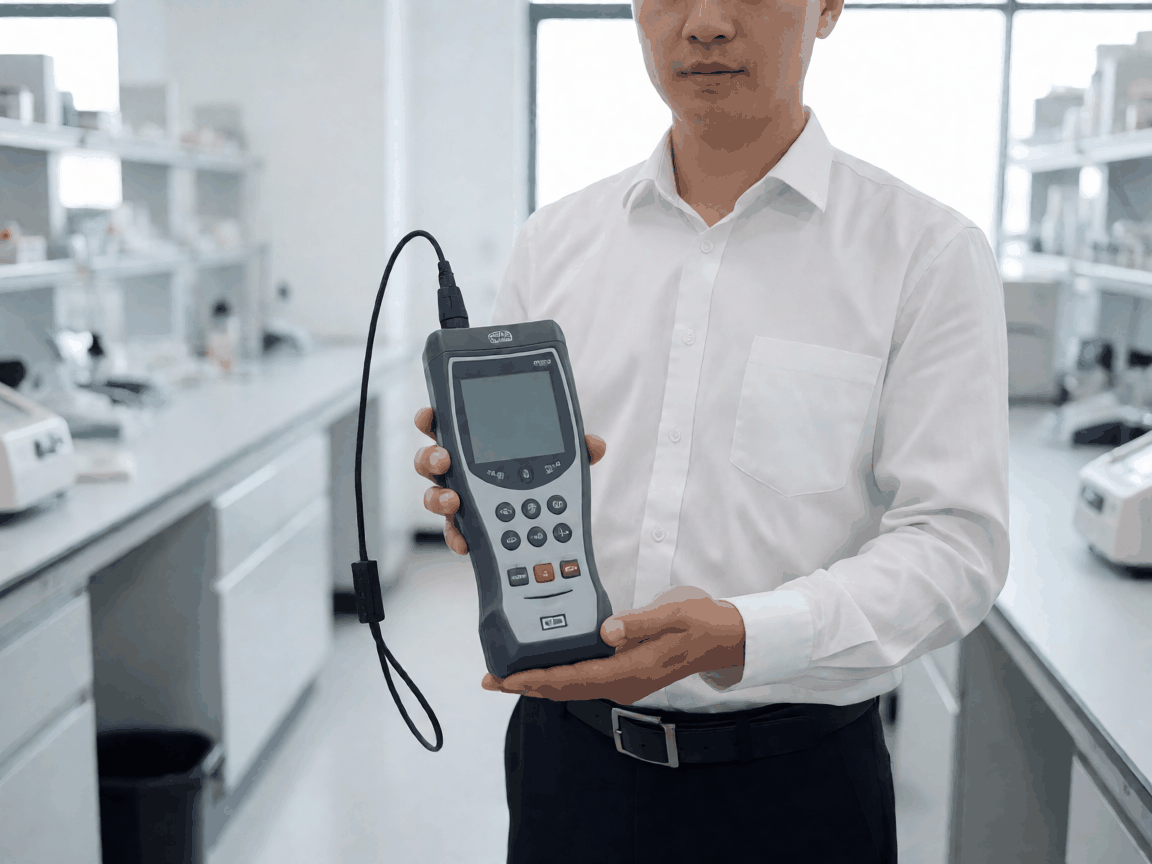
Custom Derivative (Private Label)
- Daughter board for extended range
- TFT option, IP65 gasket kit
- 10,000 records + Bluetooth/BLE
- Lead time: 6–8 weeks first article
- MOQ: 500 pcs (amortises tooling)
Customisation Options and Their Limits
| Option | Feasibility | Constraint |
|---|---|---|
| Enclosure colour (Pantone match) | Yes | 500 pcs MOQ; 10-day resin lead time |
| Custom boot/splash logo | Yes | 128×64 px mono; 2 engineer-days |
| Additional test frequency | Conditional | Requires DSP filter validation; $2,200/frequency |
| Extended temperature range (-30 °C) | No (segment LCD) | LCD fluid freezes; TFT + heater adds $22 |
| Proprietary communication protocol | Yes | Firmware branch; 3-week regression test |
| Integrated GPS tagging | No | Antenna clearance conflicts with clamp head |
Finish and colour options are limited to the bezel and carrying case. The main enclosure uses a fixed mould (dark grey RAL 7021, light grey RAL 7035, safety orange RAL 2009). Custom Pantone matches require a 500-piece resin commitment from the moulder and a 10-day colour-chip approval loop. Case foam inserts are die-cut per SKU; a new insert layout costs $350 tooling and 200 pcs MOQ. We do not offer soft-touch over-mould on the housing — the TPU layer delaminates after UV exposure in field trials.
Care, Storage and Service Life
Calibration interval drives total cost of ownership more than purchase price. IEC 61557 suggests 12-month verification; utilities often mandate 6-month cycles. Each verification consumes 25 minutes on a 5720A calibrator plus fixture time. We ship with a 12-month factory certificate; the first re-cal at the buyer's lab typically reveals 0.3–0.5% drift from the sense-resistor tempco. Units stored with alkaline cells leak potassium carbonate onto the battery-spring PCB within 14 months — remove cells for shelf storage beyond 60 days. Lithium primary cells (FR6) eliminate leakage but cost $3.20/set versus $0.45 for alkaline.
Test lead insulation fails at the strain relief first. The 2.5 mm² silicone leads rated 600 V CAT IV develop micro-cracks after 200 flex cycles at -10 °C. We specify a 30 mm over-moulded boot and 100% hi-pot at 3 kV AC/1 min. Clamp jaws accumulate ferromagnetic debris; a 0.1 mm gap adds 0.8% ratio error. Clean with isopropyl wipe before each campaign — never use abrasive pads. The USB-C port conformal coat (acrylic, 25 µm) withstands 96 hr salt spray per IEC 60068-2-11; re-coat after any housing opening.
Ordering, Tooling and Lead-Time Questions
What MOQ unlocks custom tooling amortisation?
500 pcs for daughter-board variants; 200 pcs for enclosure colour/legend changes only. Below those thresholds we quote catalogue models with pad-print branding.
How is first-article inspection structured?
We run 10 pcs through full IEC 61557-5 test sequence (resistance accuracy, voltage interference rejection, clamp phase angle) and ship FAI report with raw data. Buyer sign-off releases production; typical turnaround 5 business days.
Can we stage blanket orders with quarterly releases?
Yes. Blanket PO locks unit price for 12 months; we hold safety stock of long-lead items (LCD module, Rogowski coil) at our warehouse. Minimum release 100 pcs; 30-day call-off notice.
What artwork files are needed for private-label packaging?
AI or PDF/X-1a at 300 dpi, CMYK, 3 mm bleed. Box die-line provided on PO confirmation. Inner tray art separate from outer carton. Approval proof shipped via DHL (2 days) before print run.
How are warranty returns handled for overseas buyers?
12-month warranty ex-works. Defective units returned to our Shenzhen service centre; we cover return freight if failure replicates within 7 days of receipt. Typical root-cause: battery corrosion (30%), lead insulation (25%), display connector fretting (20%). We ship advance replacements for verified DOA within 48 hr.
Ready to finalize specifications and artwork? Share your target measurement range, annual volume, and branding files — we'll return a detailed quotation with tooling breakdown, first-article schedule, and per-unit pricing at 500/1,000/2,000 pcs within two business days.
Start the quotation and artwork review