Specifying China ground impedance earth resistance tester Manufacturer for Wholesale and OEM Orders
Material choice starts with the conditions the product will meet. A ground impedance tester spends its life in muddy substations, on scorching rooftops, in frozen switchyards, and inside humid cable vaults where condensation drips onto circuit boards. The housing polymer, probe alloy, cable jacket, and seal design aren't aesthetic decisions — they determine whether the instrument survives a single season or delivers five years of daily measurements before calibration drift exceeds the 2 % threshold that triggers replacement.
Buyers who spec solely on measurement range and accuracy miss the field-reality costs. A tester that reads 0.01 Ω resolution but cracks at -10 °C, loses probe contact after 200 insertions, or fogs its display after one monsoon season costs more per job than a slightly heavier unit with IP67 sealing, gold-plated terminals, strain-relieved cables rated for 5,000 flex cycles, and a battery compartment that stays sealed after repeated drops onto gravel. The per-unit price difference is typically $40–70; the cost of a failed safety audit or a crew stranded without a certified instrument runs into thousands.
What This Product Is and Where It Fits
Ground impedance and earth resistance testers inject a known AC test current — typically 20 mA to 200 mA at 94 Hz, 105 Hz, or 128 Hz to avoid power-line harmonics — and measure the resulting voltage drop across the grounding electrode under test. Three-pole (fall-of-potential) and four-pole (Wenner) methods cover soil resistivity surveys; selective clamp-on measurement isolates individual legs of a parallel grounding network without disconnecting bonds. CAT III 600 V or CAT IV 300 V front-end protection is the baseline for utility and industrial work; CAT II units remain common for commercial building inspection but cannot be used on service entrances.
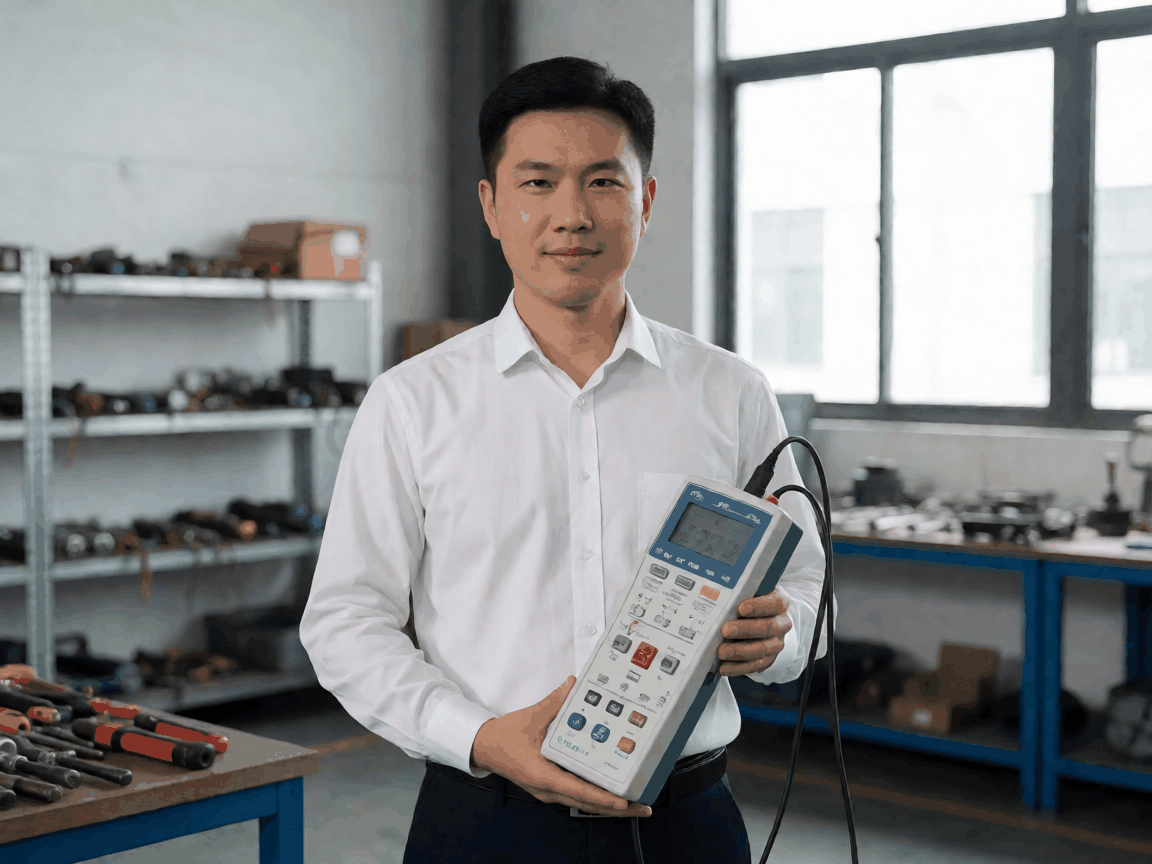
Wholesale buyers stock two distinct tiers: compact 300 g pocket models with fixed 15 m leads for electricians verifying rod-to-rod resistance on residential services, and 1.2–1.8 kg ruggedized field units with telescoping 50 m cable reels, USB data logging, and selectable test frequencies for substation commissioning. OEM customers typically rebrand the mid-range platform — 600 g, IP65, 0.001 Ω resolution, 200-hour alkaline runtime — and specify custom boot-screen logos, firmware language packs, or pre-loaded test templates aligned to local utility standards.
What the Design Has to Balance
Every gram added to the housing improves drop survival but reduces the number of units a crew carries up a lattice tower. Polycarbonate/ABS blends with 15 % glass fiber hit the sweet spot: 2 m drop onto concrete at -20 °C without cracking, 85 °C continuous operating temperature for desert deployments, and UV-stabilized color retention after 1,000 hours xenon-arc exposure. Cheaper ABS-only shells save $3–5 per unit but show stress whitening at probe ports after six months of daily cable winding.
Probe material is the next trade-off. Stainless steel 304 tips resist corrosion in acidic soils but add 120 g per set versus zinc-plated steel. Gold-plated beryllium-copper contact springs inside the probe sockets maintain <5 mΩ contact resistance after 10,000 mating cycles; nickel-plated phosphor bronze saves $0.80 per socket but oxidizes in coastal salt spray, adding 50–200 mΩ of series resistance that skews low-resistance readings. Cable jacket choice follows the same logic: PUR (polyurethane) withstands abrasion and -40 °C flexibility; PVC stiffens at -10 °C and cracks when kinked repeatedly.
Option Comparison by Usage Level
Field Electrician / Contractor Tier
- Weight: 300–450 g with batteries
- Fixed 15 m / 25 m cable sets, no reel
- Single test frequency (128 Hz typical)
- 2-line LCD, no data logging
- IP54, CAT III 300 V
- Alkaline AA × 6, 80-hour runtime
- Zinc-plated probes, PVC leads
Best for: residential rod verification, lightning protection checks, pool bonding tests. Reorder cycle: 18–24 months per crew.
Utility / Industrial Commissioning Tier
- Weight: 1.2–1.8 kg with reel
- Telescoping 50 m / 100 m cable reels
- Selectable 94 / 105 / 128 / 1367 Hz
- Color TFT, 10,000-record logging, USB-C
- IP67, CAT IV 300 V / CAT III 600 V
- Li-ion pack, 30-hour runtime, field-swappable
- SS304 probes, PUR cables, gold-plated sockets
Best for: substation grounding grids, wind-turbine earthing, pipeline cathodic protection surveys. Reorder cycle: 5–7 years with annual calibration.
Requirements by Buyer Segment
Wholesale distributors prioritize shelf-ready packaging: clamshell or molded insert with multilingual quick-start guide, hanging tab for pegboard display, and individual calibration certificate with QR code linking to PDF traceability. They order 50–200 units per SKU, expect 30-day lead time on standard firmware, and negotiate 2 % spares allowance (probes, cable sets, battery doors) included in the first shipment.
OEM and private-label buyers need firmware customization — boot logo, default language, auto-power-off timer, test-template library — and regulatory marking for their target markets (CE, UKCA, FCC, IC, RCM). MOQ starts at 200 units for firmware-only changes; 500 units if custom bezel color or silk-screen artwork is required. Lead time extends to 45–60 days for first article approval, then 30 days for repeat orders. They also demand 3-year spare-parts commitment and a defined EOL (end-of-life) notification window of 12 months.
Direct end-users — utility maintenance departments, EPC contractors — buy 5–20 units per order but require on-site demonstration, NIST-traceable calibration with ISO 17025 accreditation, and loaner-unit availability during annual recalibration. They evaluate total cost of ownership: probe replacement cost ($18–35 per tip), cable-set replacement ($45–120), battery-pack cost ($65–120), and calibration fee ($85–150 per cycle). A $150 higher upfront price that halves probe wear pays back inside the first year.
Volume Planning and Lead Time
Standard catalog models (contractor tier and utility tier) are held in semi-finished sub-assembly: main PCB loaded, housing molded, probe tips machined. Final assembly, firmware flash, calibration, and packaging take 10 working days for orders up to 500 units. Above 500 units, the line runs dedicated shifts — 1,000 units in 18 days, 2,000 units in 30 days. Custom firmware or bezel color adds 15 days for first-article validation; custom probe-tip geometry (e.g., 12 mm diameter for concrete-embedded rods) adds 20 days for tooling.
Peak season (March–June, September–November) adds 5–7 days to quoted lead times. Blanket orders with quarterly releases lock in pricing and priority scheduling; the factory reserves 15 % of monthly capacity for blanket-order fulfillment. Air freight from Shenzhen or Shanghai adds 4–6 days door-to-door for urgent replenishment; sea freight (LCL) runs 28–35 days to major US/EU ports and should be planned for annual stock builds.
Stock Availability and Reorder Planning
Contractor-tier units (3 SKUs) maintain 800–1,200 units finished-goods stock in the Shenzhen warehouse year-round. Utility-tier units (4 SKUs) carry 200–400 units due to higher Li-ion battery aging risk; batches are calibrated to order. Probe tips, cable sets, and battery doors are stocked at 3× the unit forecast to support same-day spares dispatch. Custom OEM SKUs are not stocked; they run to order with a 30-day cycle after the initial 60-day first-article.
Reorder point guidance: set minimum at 4 weeks of average weekly sales plus one standard deviation of demand variability. For a distributor moving 30 contractor units/week, that's 120 + 25 = 145 units. Utility-tier reorder point is lower (15–20 units) but lead time is longer, so safety stock must cover the 45-day custom-firmware cycle if the SKU is branded. The factory provides monthly inventory visibility via shared spreadsheet; API integration for ERP auto-reorder is available on request.
| Environmental Stress | Component | Minimum Spec for 5-Year Field Life | Cost Adder vs Baseline |
|---|---|---|---|
| -20 °C to +55 °C operational | Housing polymer | PC/ABS 15 % GF, UL 94 V-0 | +$3.20/unit |
| IP67 immersion 1 m / 30 min | Seals & battery door | Silicone gasket, captive screws, hermetic grommet | +$4.80/unit |
| Salt spray 96 h (ASTM B117) | Probe tips & sockets | SS304 tips, Au-plated BeCu sockets | +$6.50/unit |
| 5,000 flex cycles at -10 °C | Cable jacket | PUR, 4.5 mm OD, shielded pair | +$5.10/unit |
| 2 m drop onto concrete | LCD window | 3 mm polycarbonate, hard-coat both sides | +$2.70/unit |
| 1,000 h xenon arc UV | Housing color | UV-stabilized masterbatch, ΔE < 2 | +$0.90/unit |
Next Steps: Request Evaluation Units
Two calibrated evaluation units — one contractor tier, one utility tier — ship within 5 business days against a purchase order or signed loan agreement. Each kit includes probes, cables, batteries, calibration certificate, and a 30-day return window with prepaid return label for qualified accounts. Firmware customization samples require a 50 % tooling deposit and 20-day lead time.
Submit your application notes and annual volume estimate to receive a tailored specification sheet, pricing tiers, and the current calibration-lab accreditation schedule.