custom advanced earth ground resistance tester suppliers: What Buyers Should Check Before Ordering
Comparing Two Standard Configurations
The limiting factor is rarely the headline specification; it is how the instrument behaves when the soil is dry, the test leads are long, or the operator is wearing gloves. Two configurations dominate the catalogues of custom advanced earth ground resistance tester suppliers.
Three-Pole Fall-of-Potential
Measures resistance by injecting a low-frequency current (typically 128 Hz) between the earth electrode and a current stake, while sensing voltage at a potential stake.
- Range: 0.01 Ω to 20 kΩ, resolution down to 0.001 Ω on the lowest range.
- Test current: up to 20 mA rms, adjustable to reduce electrode polarisation.
- Best for: new installations, small grids, and where stake placement is practical.
Four-Pole Selective with Clamp
Adds a current clamp to measure the test current directly on the conductor, eliminating the need to disconnect the earth system.
- Range: 0.001 Ω to 30 kΩ, with 0.0001 Ω resolution on the milliohm range.
- Test current: up to 50 mA rms, multiple frequencies (94 Hz, 105 Hz, 111 Hz, 128 Hz) to reject noise.
- Best for: live systems, large substations, and sites where downtime is unacceptable.
Buyers often specify the three-pole unit for price, then discover the clamp option is mandatory for maintenance contracts that forbid de-energising. The cost delta is roughly 35–45 % at the factory gate, but the clamp version reduces on-site labour by half on typical utility jobs.
What Can Be Customised and What Cannot
Fatigue appears at the stress concentration where the probe cable meets the moulded strain relief. Customisation that moves that joint or changes the cable jacket material directly affects field failure rates.
Critical rule: the safety category (CAT III 600 V / CAT IV 300 V) and the intrinsic measurement architecture are fixed by the certified design. Any change to the front-end amplifier or the isolation barrier requires a full re-certification cycle — typically 12–18 weeks and a new type-test report.
Available Customisation Levers
- Housing colour and texture (see finish table below) — impacts UV resistance and chemical splash tolerance.
- Display type: transflective monochrome (sunlight readable) vs. colour TFT (better for data logging screens).
- Memory depth: 1,000 to 50,000 records, with or without time-stamp battery backup.
- Communication: USB-C only, USB-C + Bluetooth LE, or USB-C + Wi-Fi for cloud sync.
- Probe cable length and connector style (banana, BNC, or proprietary locking).
- Calibration certificate: factory traceable, ISO 17025 accredited, or customer-specified test points.
| Option | Standard Choices | MOQ Impact |
|---|---|---|
| Housing colour | Yellow (RAL 1023), Orange (RAL 2009), Grey (RAL 7035), Custom Pantone | Standard colours: 50 pcs; Custom colour: 200 pcs |
| Display backlight | White LED, Amber LED, RGB (software selectable) | White/Amber: 50 pcs; RGB: 100 pcs |
| Probe cable jacket | PVC (standard), PUR (oil/abrasion resistant), TPE (extreme cold flexibility) | PVC: 50 pcs; PUR/TPE: 150 pcs |
| Branding area | Pad-print (1 colour), Laser etch, Domed label (full colour) | Pad-print: 100 pcs; Laser: 50 pcs; Domed: 200 pcs |
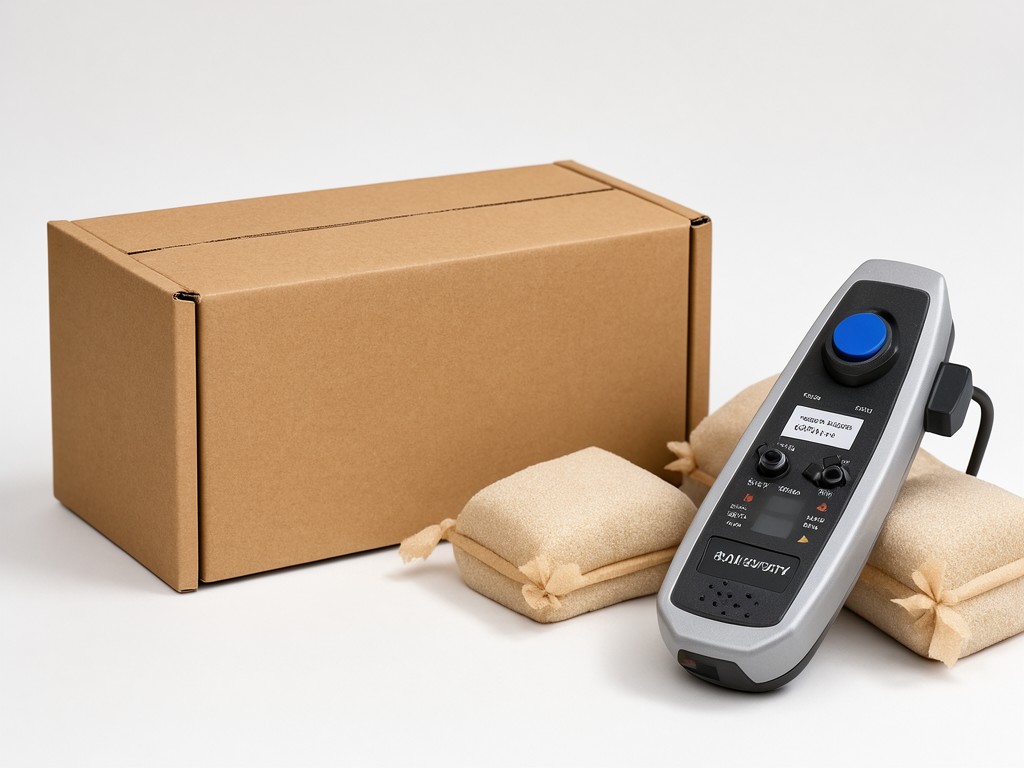
Private-label buyers should note that the battery compartment door and the calibration seal are mandated by the safety standard and cannot carry a logo without voiding the type test.
Requirements by Buyer Segment
An importer stocking a regional warehouse needs a different package than a private-label brand selling through electrical distributors.
Importer / Distributor
- Consistent carton dimensions for pallet optimisation (typically 12 units per master carton, 48 per Euro pallet).
- Multi-language quick-start guides (EN, FR, DE, ES, PL, AR) included in the box.
- Spare parts kit (fuses, test leads, battery door) available as a separate SKU with 5 % overpack.
Private-Label Brand
- Custom firmware splash screen and menu logo (one-time NRE, amortised over 500 units).
- Dedicated calibration certificate template with brand header and QR code linking to brand portal.
- Exclusive colourway locked for 24 months via a side letter — prevents the same housing colour appearing on a competitor's SKU.
Both segments require batch traceability to the PCB assembly lot and the final calibration date code. The difference is whether that data lives on a generic label or a branded one.
Quality Control and Batch Consistency
Weight and stiffness trade off against each other in the probe cable, but the real consistency risk is the front-end amplifier's input bias current drift over temperature. Every batch undergoes a three-step gate:
- Automated electrical test at 23 °C: verification of all measurement ranges against calibrated decade boxes, pass/fail logged per serial number.
- Thermal soak: 2 hours at -10 °C and +50 °C, then repeat accuracy check at extremes. Units exceeding ±0.5 % of reading + 2 digits are segregated for rework.
- Mechanical stress: 1 m drop onto concrete (six faces), IP54 spray test, and 10,000 cycles of probe cable flex at 90° bend radius.
Statistical process control charts track the mean and sigma of the 1 Ω reference resistor on the calibration board. A shift of 0.1 % triggers a tooling review of the laser-trim process. This is the metric that predicts field calibration drift six months later.
What Gets Checked Before Shipment
The final inspection is not a sample audit — it is 100 % on the critical safety and accuracy parameters.
- Dielectric withstand: 5.2 kV DC between measurement terminals and enclosure for 60 seconds (per IEC 61010-2-030).
- Earth continuity: < 0.1 Ω from probe shells to the protective earth terminal.
- Accuracy spot-check at 1 Ω, 100 Ω, 1 kΩ, and 10 kΩ using a calibrated Fluke 5522A. Deviation > 0.25 % fails the unit.
- Display and keypad functional test: all segments, backlight levels, and button actuations.
- Battery compartment torque: 0.45 N·m ± 0.05 N·m on the captive screws.
- Packaging integrity: carton drop test (ISTA 1A) on the first and last carton of each pallet.
A certificate of conformity referencing the batch number, test equipment IDs, and the operator stamp ships with every pallet. Digital copies are uploaded to the buyer's portal within 24 hours of container loading.
Export Packaging and Handling Protection
Moisture ingress during trans-shipment is the silent killer of calibration stability. The standard export pack addresses three vectors:
- Inner anti-static bag (surface resistivity 10⁹–10¹¹ Ω/sq) with a desiccant sachet (2 units of 5 g silica gel per instrument).
- Moulded polyethylene foam inserts that cradle the tester and the probe set separately — prevents the probe pins from scratching the display during vibration.
- Double-wall corrugated master carton (ECT 48) with edge protectors, strapped to a heat-treated ISPM-15 pallet. Pallet stretch wrap includes a VCI (volatile corrosion inhibitor) layer for sea freight > 30 days.
Labeling follows the buyer's spec: GS1-128 barcode on two adjacent sides, handling icons (keep dry, this side up, fragile), and a peel-off customs declaration pouch. For air freight, the lithium-ion battery (if fitted) is declared as UN 3481 Section II, with the state-of-charge capped at 30 %.
Ready to Review Artwork and Branding?
Send your logo files, colour references, and firmware splash-screen assets. We'll return a digital proof within two business days and a physical pre-production sample within ten.
Request Artwork Review