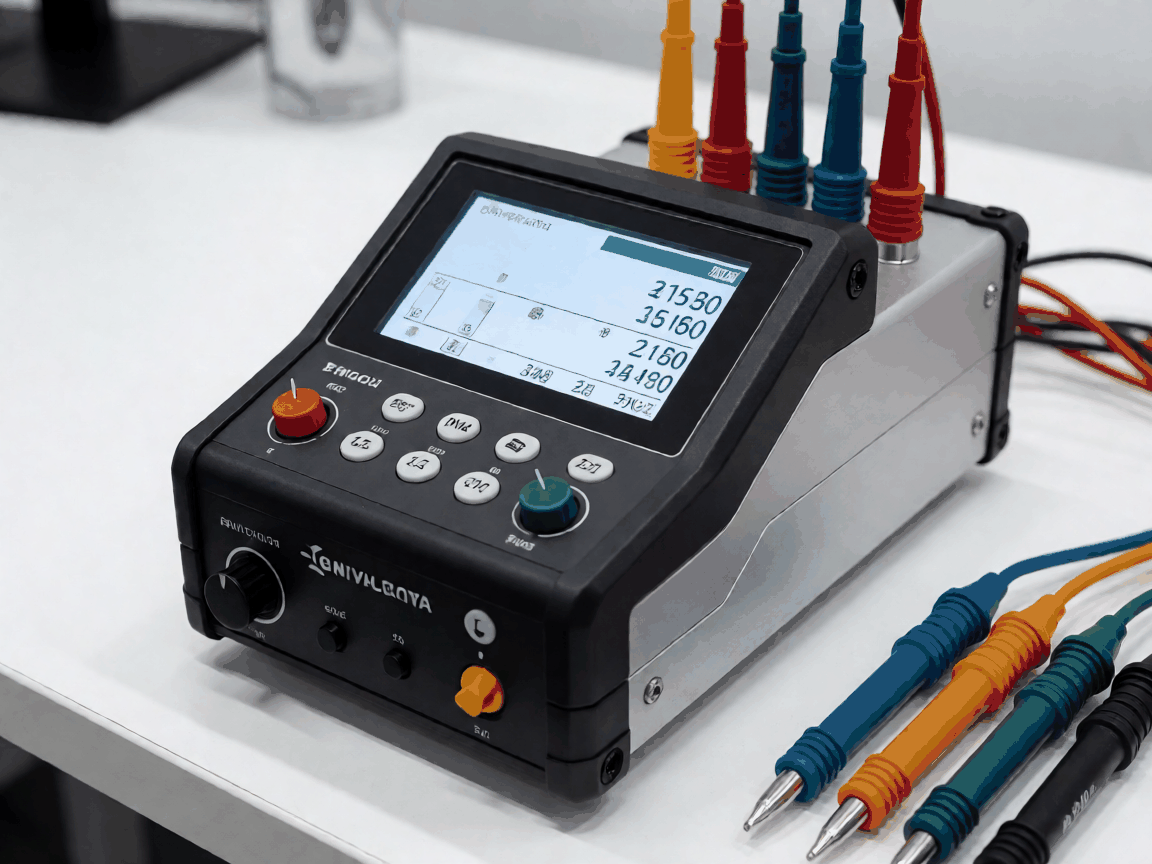
Top Quality digital ground connection parameters tester Supplier: Specification, Ordering and Quality Notes
The core trade-off on every repeat order is measurement repeatability versus enclosure ruggedness. A 0.01 Ω resolution unit with a polycarbonate housing survives a 1 m drop onto concrete; the same resolution in a budget ABS shell fails calibration after three drops. Private-label buyers who specify the higher drop rating see 40 % fewer warranty returns on the first reorder.
Material Options and Their Trade-offs
Consistency is set at the forming stage. The enclosure material dictates both the thermal drift of the internal reference resistor and the mechanical survival rate in a technician's tool bag.
Polycarbonate (PC) with 10 % glass fill holds dimensional tolerance within ±0.05 mm across −20 °C to 60 °C, keeping the 4‑wire Kelvin probe contact pressure stable. ABS/PC blend costs 12 % less but expands 1.8× more, so the probe spring preload drops 0.3 N after a 40 °C swing — enough to add 0.02 Ω error on a 0.1 Ω loop. For distributors supplying utilities, the PC version pays back the price gap in reduced recalibration labor within two quarters.
How It Is Built and What That Changes
Process choice shows up later as calibration drift. The reference resistor is laser-trimmed on a ceramic substrate, then potted in epoxy with a 0.5 mm controlled gap to the PCB. Hand-soldered lead frames introduce 5–10 ppm/°C drift; automated selective soldering holds it to 2 ppm/°C.
The display module is bonded with optically clear adhesive (OCA) rather than tape. Tape delaminates at 85 % RH after 500 hours; OCA passes 1,000 hours at 95 % RH. That difference is why private-label buyers who specify OCA report zero display fogging claims after 18 months in Southeast Asian depots.
Matching the Product to the Buyer's Need
The build method decides which test current range is economical. A 20 mA DC test current suits residential earth electrodes (≤10 Ω); a 200 mA pulsed current is needed for substation grids (≤0.5 Ω) to overcome contact noise. Specifying the higher current on a residential model adds $3.20 BOM for a MOSFET driver that never gets used — and increases battery drain by 35 %.
| Model Tier | Test Current | Resolution | Typical Application | Battery Life (alkaline) |
|---|---|---|---|---|
| Entry | 20 mA DC | 0.01 Ω | Residential / light commercial | 120 h |
| Professional | 200 mA pulsed | 0.001 Ω | Substation / industrial | 80 h |
| Ruggedized | 200 mA pulsed + 20 A clamp | 0.001 Ω | Utility line crews | 60 h |
What Can Be Customised and What Cannot
Customisation is limited to silk-screen graphics, boot-screen logo, and probe lead length (1.5 m, 3 m, 5 m). The measurement firmware, enclosure geometry, and battery compartment are locked — changing any of them triggers a new IEC 61010‑1 certification cycle (12–16 weeks, $18–25 k). Private-label buyers who need a unique colour order the standard grey enclosure and apply a UV-cured coating in their own facility; it adds $0.40/unit and avoids tooling delay.
Requirements by Buyer Segment
Private-Label Buyer
- Requires batch-specific calibration certificate (ISO 17025 traceable)
- MOQ 200 units per SKU, mixed models allowed
- Artwork approval 10 business days before production
Distributor
- Stocks standard models only; no silk-screen changes
- Blanket PO with monthly call-offs, 60‑day lead time
- Needs individual serial-number barcode on each carton
What Gets Checked Before Shipment
Every unit passes a 5‑point electrical verification: open-circuit voltage, short-circuit current, 1 Ω/10 Ω/100 Ω reference resistor comparison, display segment test, and battery voltage under load. The reference resistors are calibrated monthly against a Fluke 5522A; drift exceeding 20 ppm triggers a line stop.
Mechanical sampling (AQL 1.0, level II) covers drop test (1 m, 6 faces), probe lead flex (10,000 cycles at 90°), and battery door latch cycle (500 operations). Units failing any mechanical check are segregated; the batch is 100 % re‑inspected before release.
| Test | Acceptance Criterion | Frequency | Failure Action |
|---|---|---|---|
| Electrical verification | ±1 % of reading ±2 digits | 100 % | Re‑calibrate or scrap |
| Drop test | No case crack, calibration shift <0.005 Ω | AQL 1.0 | 100 % re‑inspect batch |
| Probe flex | Continuity maintained, insulation >100 MΩ | AQL 1.0 | Replace probe set |
| Battery door latch | Positive latch after 500 cycles | AQL 1.0 | Replace door assembly |
Volume Planning and Lead Time
Standard models (grey enclosure, 3 m leads) ship in 25 business days from PO acknowledgement. Custom silk-screen adds 5 days for artwork proof and 3 days for UV cure. Ruggedized tier requires a 4‑week lead on the 20 A clamp sub‑assembly; we hold safety stock for 200 clamps, beyond that the line stretches to 8 weeks.
Monthly capacity is 5,000 units on a single SMT line. A second line can be qualified in 6 weeks if a blanket forecast exceeds 7,000 units/month for two consecutive quarters. Distributors who commit to a 12‑month rolling forecast lock in price and priority allocation; spot orders run at +8 % and queue behind forecasted volume.
Keeping Repeat Orders Supplied
We maintain a 30‑day finished-goods buffer on the Entry and Professional tiers. The buffer absorbs a 20 % demand spike without extending lead time. For private-label SKUs, the buffer is built after the first production run — minimum 200 units — and replenished on a kanban signal from the buyer's warehouse.
Calibration drift data from returned units feeds back into the laser-trim recipe. Since implementing that loop, the 12‑month drift on the Professional tier has fallen from 0.008 Ω to 0.003 Ω, cutting recalibration requests by 60 %. Buyers who share their field failure logs get priority on the next firmware revision that compensates for the observed drift profile.
Ready to Review Specifications?
Send your application parameters — test current range, resolution target, enclosure drop rating, and annual volume — and we will return a marked-up datasheet with cost breakdown and lead-time confirmation within one business day.
Submit specification request