bulk transformer turns ratio tester price: Specification, Ordering and Quality Notes
What Actually Determines Performance
Tooling amortisation decides the real cost structure long before a purchase order lands. A turns ratio tester that drifts 0.2% after six months of daily field use costs more in rework and credibility than the delta between a $1,200 unit and a $1,800 unit. The spec that matters is not the headline accuracy — typically 0.1% or 0.2% of reading — but how that accuracy holds under the conditions the instrument actually sees: 40°C in a substation yard, condensation cycling, vibration in a service truck, and the occasional 20V excitation across a 500 kVA transformer where the magnetising current masks the ratio signal.
Excitation voltage range is the first filter. Units capped at 8V or 10V cannot properly saturate large power transformer cores, so the measurement relies on low-flux linearity that varies with residual magnetism. A 40V or 100V excitation capability adds $200–$400 to the BOM — precision high-voltage DACs, isolated gate drivers, and creepage-compliant PCB layout — but it eliminates the "re-test after demagnetisation" loop that burns two hours per unit on site. For a crew doing ten transformers a week, that loop costs more than the instrument premium in the first month.
Phase measurement is the second filter. Single-phase testers require manual lead swapping for three-phase banks; three-phase units measure all windings simultaneously and compute vector group automatically. The price gap is $600–$1,000, but the labour delta is 15 minutes versus 90 minutes per bank. If your crews touch three-phase units regularly, the single-phase tester is a false economy.
How It Is Built and What That Changes
Enclosure and Isolation Trade-offs
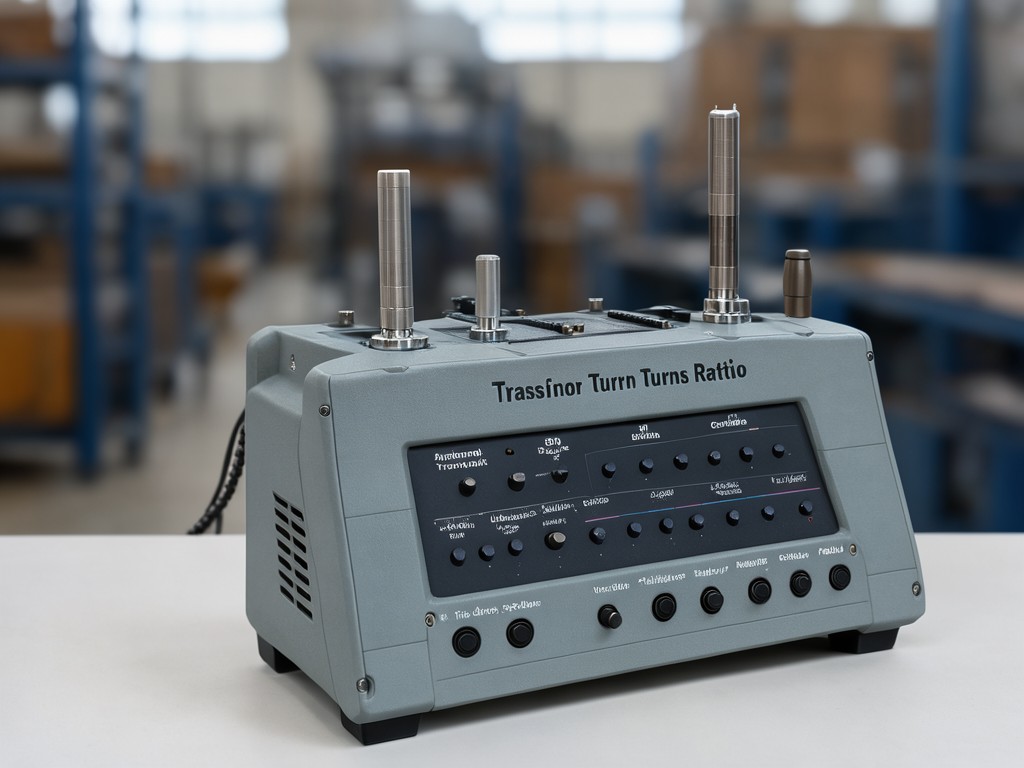
Handheld polycarbonate shells (IP54, IK07) survive drops onto concrete but limit internal clearance for 100V excitation circuits — creepage distances force a larger board or lower voltage. Bench-top aluminium enclosures (IP40) allow full creepage for 100V/200V ranges and better thermal dissipation for continuous testing, but they add 2.5 kg and require AC mains or a separate battery pack.
The decision point: if 80% of jobs are pole-top or pad-mount transformers where the tech carries the tester up a ladder, the handheld form factor wins despite the voltage ceiling. If the bench sees factory acceptance testing or repair shop throughput, the bench-top pays back in calibration stability and operator fatigue.
Internal architecture follows the same logic. Handheld units use a single high-voltage transformer with relay-switched taps for excitation levels; bench-top units often run dual-transformer topologies (one for low-voltage precision, one for high-voltage saturation) to keep noise floor below 0.05% at 0.8V while still delivering 100V clean. The dual-transformer BOM adds $180 but removes the relay contact resistance drift that shows up as 0.1% ratio error after 5,000 cycles.
Display and interface choices cascade into field usability. Sunlight-readable transflective LCDs (400 nits effective) cost $45 more than standard backlit TFT but remain legible at 80° incidence without a hood. Capacitive touch fails with lineman gloves; tactile membrane keypads or rotary encoders add $12 but work at -20°C with Class 00 gloves. We spec the encoder for utility fleets, the touchscreen for rental houses where UI familiarity drives re-rental rate.
Who Uses It and Where It Matters
| User Segment | Typical Test Volume | Voltage Need | Form Factor | Calibration Cycle |
|---|---|---|---|---|
| Utility T&D crews | 5–15 units/week | 40V min, 100V preferred | Handheld, IP54 | 12 months, NIST traceable |
| Transformer repair shops | 20–50 units/week | 100V–200V, three-phase | Bench-top, AC powered | 6 months, in-house reference |
| Rental fleets | Variable, high turnover | 40V covers 90% of demand | Handheld, ruggedised | 12 months, rental-return check |
| Factory acceptance (OEM) | High throughput, automated | 200V, three-phase, IEC 60076 | Rack-mount, SCPI/Modbus | 3–6 months, statistical process control |
The table above is not a menu — it is a filter. A distributor stocking for utility crews should not carry the 200V rack-mount unit; the rental house should not stock the single-phase 8V handheld. Each segment has a different failure mode: utilities lose accuracy to connector corrosion, repair shops lose throughput to manual lead changes, rental fleets lose units to display cracking, OEMs lose traceability to calibration drift. The spec sheet that matches the segment reduces total cost of ownership by 30–50% versus the "one size fits all" quote.
What Gets Checked Before Shipment
Total cost of ownership shifts once returns are counted. Every unit leaves our line after a four-stage gate that mirrors the complaints we actually see from the field, not the checkboxes on a generic QC form.
Stage 1: High-pot isolation at 3.7 kVAC (handheld) or 5.2 kVAC (bench-top) per IEC 61010-1 CAT IV 600V. This catches potting voids in the excitation transformer and creepage shortcuts on the HV board — the two failure modes that turn into safety incidents. We hold 100% test, not sampling, because a single field failure triggers a fleet recall.
Stage 2: Ratio accuracy verification at five points (0.8V, 8V, 40V, 100V, 200V where applicable) against a 0.01% class reference transformer. We log the as-found and as-left data per serial number; the CSV ships with the unit. If a buyer's incoming inspection uses a different reference, the traceability chain is intact — no "he said/she said" on calibration disputes.
Stage 3: Environmental soak — 4 hours at -20°C, 4 hours at +55°C, 95% RH non-condensing, powered and measuring a stable load. We verify display contrast, keypad response, and battery voltage reporting at extremes. Units that drift >0.05% between -20°C and +25°C are pulled for thermal compensation firmware adjustment.
Stage 4: Mechanical shock (IK07 equivalent: 20 joule impact on each face) and vibration sweep (10–500 Hz, 2g, 30 min/axis). Post-shock, we re-run Stage 2. Connector solder joints, BGA underfill, and display flex cables are the weak links; this gate catches the 2% that would fail within 90 days of truck vibration.
Volume Planning and Lead Time
| Order Quantity | Lead Time (Handheld) | Lead Time (Bench-top) | Customisation Window | Price Break |
|---|---|---|---|---|
| 1–9 units | 3–5 business days (stock) | 5–7 business days (stock) | Logo overlay only | List price |
| 10–49 units | 2–3 weeks | 3–4 weeks | Logo + custom boot screen + carrying case insert | -5% from list |
| 50–199 units | 4–5 weeks | 5–6 weeks | Full artwork, custom test report template, dedicated calibration sticker | -10% from list |
| 200+ units | 6–8 weeks | 7–9 weeks | Firmware feature flags, custom voltage ranges, co-branded manual | -15% from list + fixed 12-month price lock |
Replacement rate, not unit price, drives the negotiation at 50+ units. A fleet manager buying 100 handhelds for a three-year deployment cares about the 2% annual attrition from display delamination and connector fatigue. We address that by specifying conformal coating grade (IPC-CC-830 Class B vs. Class A), potting compound shore hardness (60A vs. 85A for vibration), and display adhesive cure profile — line items that add $8/unit but cut field replacement rate from 2% to 0.3%. The price break table above assumes standard spec; the real discount lives in the spec freeze.
Customisation window is the hidden lead-time driver. Artwork approval (logo placement, Pantone match, case mould texture) takes 5–7 business days round-trip if the buyer has vector assets ready; raster logos or unresolved colour specs add two weeks. Firmware feature flags (disabling unused voltage ranges, locking calibration menu, pre-loading customer test templates) require a 10-unit pilot build and two-week field validation before full release. We build that pilot into the 50-unit lead time, not after.
Next Steps: Spec Freeze and Artwork Review
The quotation is not a price list — it is a spec agreement. Before we cut a PO, we need: target user segment (from the table above), excitation voltage minimum, phase requirement, form factor, calibration documentation format, and artwork assets (vector logo, Pantone codes, case texture preference). With those locked, we issue a controlled drawing set for sign-off, build the pilot batch if customisation applies, and ship to schedule.
Submit your spec requirements here and we return a configured BOM, lead time, and unit price within one business day. No generic quotes — only the configuration that matches your crew's actual workload.