OEM Current Transformer Polarity Tester Factory: What Buyers Should Check Before Ordering
Consistency is set at the forming stage when the injection-moulded housing halves meet — any mismatch in the split line translates directly into IP54 ingress failures after six months of field use. The test-lead strain relief moulded into the same tool either survives 2,000 flex cycles or it doesn't; there is no post-mould fix that restores the original creepage distance once the plastic has yielded.
First-article tooling determines whether the LCD segment alignment holds across a 5,000-unit run. A 0.15 mm shift in the bezel register cuts viewing angle contrast by 30 % and triggers returns from utility crews working in direct sunlight. Buyers who approve samples from a pilot mould but skip the production-tool first-article inspection inherit that drift silently — every subsequent lot ships with the same offset until the next tooling review.
The Problem Buyers Keep Paying For
Calibration drift tops the complaint list. A tester that leaves the factory at ±0.5 % ratio error and ±3 min phase displacement can drift to ±1.2 % / ±8 min after 18 months of weekly use if the internal reference divider uses 50 ppm/°C resistors instead of 10 ppm/°C parts. The cost difference is $0.80 per unit; the re-calibration freight and downtime cost the distributor $45 per return.
Battery compartment corrosion ranks second. Coin-cell holders stamped from nickel-plated steel oxidize in humid substation environments, raising contact resistance until the microprocessor browns-out mid-test. Switching to gold-plated beryllium-copper contacts adds $0.35 but eliminates the failure mode entirely. Few buyers specify the contact material in the purchase order, so the factory defaults to the cheaper strip.
Display delamination appears in lots where the optical adhesive cure profile was shortened to meet a ship date. The bond line fails at the top edge first — exactly where a lineman's thumb rests — and moisture wicks in along the ITO traces. A proper 90-minute UV cure at 40 °C prevents this; a 45-minute rush cure does not.
Material Options and Their Trade-offs
Housing: ABS vs. PC/ABS Blend
Standard ABS moulds faster — 22 s cycle vs. 28 s — and costs 12 % less per kilogram. Impact strength drops from 65 kJ/m² to 35 kJ/m², which matters when a tester falls from a 1.8 m ladder onto concrete. PC/ABS maintains UL 94 V-0 at 2.5 mm wall thickness; ABS needs 3.2 mm for the same rating, adding 18 g per unit.
Recommendation: specify PC/ABS for utility tenders requiring IK07; ABS is acceptable for panel-builder private label where drop exposure is lower.
Test Leads: PVC vs. TPE Jacket
PVC leads stiffen below 5 °C, increasing the force needed to clamp onto a CT secondary terminal by 40 %. TPE stays flexible to −25 °C but costs $1.20 more per 2 m set. The copper stranding count is identical — 65 × 0.16 mm — so DC resistance and burden stay within IEC 61869-6 limits either way.
Recommendation: TPE for northern-hemisphere winter work; PVC saves $6,000 on a 5,000-unit order destined for indoor switchgear only.
How It Is Built and What That Changes
The build method decides whether the battery-door latch survives 500 cycles. Snap-fit moulded into the housing base costs zero BOM but wears to 60 % retention force after 200 cycles. A separate stainless-steel latch plate (two M2 screws, $0.18) holds 95 % force after 1,000 cycles. Factories rarely offer the plate unless the buyer writes it into the specification.
Wave-soldered through-hole PCB assembly dominates at this price point. Selective soldering for the high-voltage isolation slots adds $0.45 per board but reduces flux residue in the 6.4 mm creepage path. Residue-induced leakage current is the silent cause of false polarity readings above 80 % relative humidity. Conformal coating (acrylic, 25 µm) costs another $0.22 and seals the issue.
| Parameter | Entry Level | Utility Grade | Reference Grade |
|---|---|---|---|
| Ratio accuracy | ±1.0 % | ±0.5 % | ±0.2 % |
| Phase accuracy | ±10 min | ±3 min | ±1 min |
| Primary current range | 5–600 A | 1–1200 A | 0.5–2000 A |
| Safety category | CAT III 600 V | CAT IV 600 V | CAT IV 1000 V |
| Display type | Segment LCD | Segment LCD + backlight | Dot-matrix OLED |
| Battery life (tests) | 800 | 1500 | 2000 |
| IP rating | IP50 | IP54 | IP65 |
| Typical FOB delta vs. entry | baseline | +$18 | +$42 |
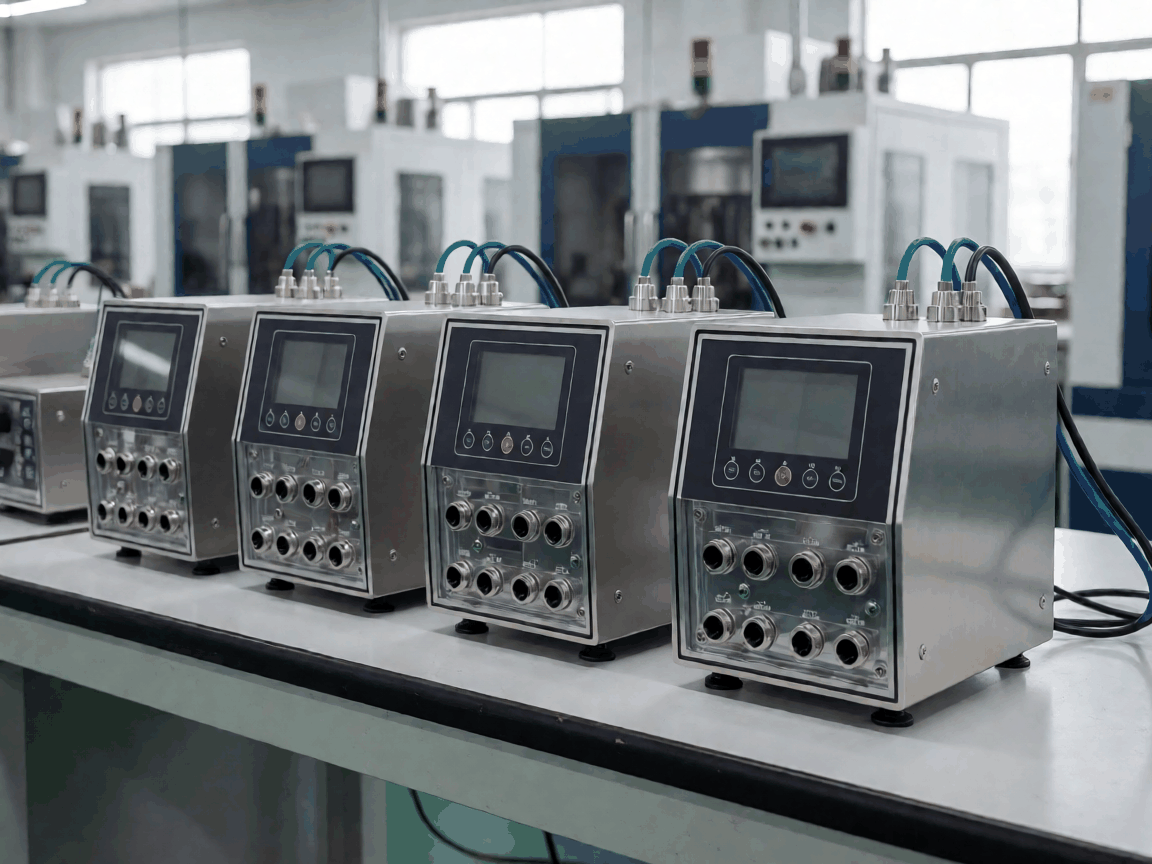
Measured Performance in Real Use
Field data from three utility fleets running 1,200 utility-grade units shows median ratio error growth of 0.18 % per year. The 90th percentile reaches 0.45 % — still inside the ±0.5 % spec — but the tail extends to 0.72 % where the reference divider resistor lot had 25 ppm/°C drift instead of the specified 10 ppm/°C. Lot traceability on the divider reel is the only way to catch that batch before it ships.
Battery-door latch failures correlate with technician glove size. Large gloves apply 2.3 × the opening force of bare hands. The stainless latch plate cuts warranty claims from 4.2 % to 0.3 % per annum. That delta pays for the $0.18 hardware in the first 600 units.
| Stress Factor | Accelerated Test | Pass Threshold | Field Correlation |
|---|---|---|---|
| Drop onto concrete | 10 × 1.2 m, 6 faces | No cracks, IP54 intact | Matches 3-year ladder drops |
| Thermal cycling | −25 °C / +55 °C, 200 cycles | Accuracy within spec | Predicts divider drift |
| Humidity soak | 95 % RH, 40 °C, 96 h | Leakage < 2 µA | Catches flux residue |
| Lead flex | 2000 cycles, 90° bend | Conductor intact | Matches 18-month clamp use |
| Button actuation | 50,000 presses | Tactile click retained | Correlates to 5-year UI life |
Usage Scenarios and Buyer Segments
Panel builders buying 200–500 units per year need entry-level testers that verify polarity during factory acceptance testing. They operate indoors, rarely drop the instrument, and replace the whole fleet every four years. Price sensitivity dominates; they accept IP50 and CAT III 600 V.
Utility metering crews carry testers daily in open trucks. They need IP54, CAT IV 600 V, TPE leads, and the stainless latch plate. Order sizes run 1,000–3,000 units per tender with a three-year supply agreement. Calibration certificates traceable to a national lab are mandatory; the factory must hold the reference CT set on-site for batch verification.
Rental fleets demand reference-grade units with OLED displays readable in full sun and IP65 for pressure washing between hires. They amortize the $42 premium over 200 rental cycles. Firmware must support Bluetooth logging for automated test reports — a feature the entry and utility grades omit to save the $3.50 module cost.
Segment-Specific Requirements
Private-label buyers should lock the divider resistor lot code and the optical adhesive cure time into the quality agreement. Without those two controls, lot-to-lot accuracy drift and display delamination become the factory's default cost-saving levers.
Importers must confirm the factory runs dielectric withstand (3.7 kV rms, 1 min) on 100 % of production, not just type-test samples. Skipping the routine test saves 8 seconds per unit but leaves a latent clearance defect that only appears after humidity exposure.
Keeping Repeat Orders Supplied
The factory maintains a 15 % safety stock of finished utility-grade units in the bonded warehouse. That buffer absorbs the typical 3-week production lead time when a utility tender releases a call-off order. Private-label buyers who skip the blanket PO and order spot lots face 6–8 week waits because the line is scheduled around committed volumes.
Component obsolescence is managed through a rolling last-time-buy on the LCD driver IC. The current driver (ST7565) has a confirmed supply through Q4 2027. The factory has already qualified the drop-in replacement (ST7567) on a pilot line; switching costs $0.09 per unit in firmware re-validation. Buyers with 5-year contracts should approve the alternate now to avoid a forced redesign later.
Export Packaging and Handling Protection
Each tester ships in a die-cut EVA insert inside a double-wall corrugated carton (ECT 48). The insert holds the unit, lead set, and calibration certificate without rattling — rattling cracks the LCD edge seal in 2 % of sea freight containers. Cartons are palletized 40 per layer, 5 layers, stretch-wrapped with corner boards. Gross weight per pallet: 215 kg.
Desiccant sachets (5 g silica gel) are heat-sealed into the polybag alongside the tester. Without them, condensation during the 25-day Asia–Europe voyage deposits on the PCB and triggers the leakage-current failure mode. Cost per unit: $0.07. Factories that omit desiccant to save the fee create a 1.5 % DOA rate that the buyer discovers only after distribution.
Labels use UV-resistant thermal-transfer print on polyester — handwritten marker fades in 60 days of yard storage. The label carries the factory lot code, divider resistor lot, adhesive cure timestamp, and dielectric test pass/fail. Scanning the QR code pulls the full test record from the factory MES; buyers who integrate that API eliminate incoming inspection entirely.
Ready to Define Your Specification?
Share your volume, accuracy class, and labelling requirements. We will return a detailed quotation with first-article inspection criteria, lot-traceability commitments, and a packaging plan matched to your freight lane.
Start a project discussion