b2b electrical conductor resistance test meter manufacturer: What Buyers Should Check Before Ordering
Most quality disputes start with a consistency gap between the specification sheet and what actually arrives on the loading dock. A resistance meter that reads 0.05% accuracy in the lab can drift to 0.2% after six months of daily 100 A test cycles if the current-shunt alloy and thermal layout were not locked down during the design review. Buyers who treat the instrument as a commodity SKU instead of a calibrated measurement system end up owning a fleet that cannot hold a single tolerance band across shifts.
Wear shows up at the same point every season: the Kelvin clip jaws lose spring force, the four-wire cable harness develops micro-fractures at the strain relief, and the front-panel membrane switch begins to ghost keystrokes. These are not random defects — they are predictable outcomes of material choices made before the first PCB is populated. A procurement officer who knows which alloy, which connector cycle rating, and which conformal-coat thickness correspond to a three-year calibration interval can write a purchase order that survives a factory audit without a single engineering change order.
Material Options and Their Trade-offs
Specification lock point: the current-sensing shunt alloy determines both the temperature coefficient and the long-term drift rate. Manganin (Cu-Mn-Ni) holds ±15 ppm/°C but ages ~50 ppm/year under 100 A continuous duty. Zeranin (Cu-Ni-Sn) improves drift to ~20 ppm/year at the cost of a wider ±25 ppm/°C coefficient. Evanohm (Ni-Cr-Al-Mn) offers the lowest drift (~10 ppm/year) but requires a 4-wire Kelvin connection at the shunt terminals themselves to avoid lead-resistance error. Choose the alloy before you approve the schematic — changing it later forces a full recalibration campaign.
Enclosure material drives both EMI shielding and drop survival. Die-cast aluminum (ADC12) with 2.5 mm wall thickness passes a 1 m concrete drop per IEC 61010-1 and provides >60 dB attenuation at 150 kHz–30 MHz. ABS/PC blend saves 35% weight and 20% tooling cost but drops shielding to ~35 dB and fails the same drop test unless ribbed internally. For private-label buyers targeting industrial MRO catalogs, the aluminum chassis is the default; for handheld battery-operated models sold through electrical distributors, the composite shell wins on freight cost and single-hand ergonomics.
Test lead insulation is the third material decision that survives every reorder. Silicone rubber (150 °C rated) stays flexible at −20 °C and resists soldering-iron contact, but the surface tack attracts metal swarf in wire-harness shops. TPE (105 °C) rejects debris and costs 40% less per meter, yet stiffens below 0 °C and cracks after 5,000 flex cycles at 180° bend radius. Specify the jacket compound in the cable drawing, not in the purchase order notes — otherwise the cable subcontractor will substitute the cheaper grade and the first field failure will trace back to your BOM.
How It Is Built and What That Changes
The complaint that repeats across reorders is calibration drift traced to a single solder joint on the sense-lead input. A four-layer PCB with dedicated analog ground plane, guard rings around the instrumentation amplifier, and 0.1% thin-film resistors (25 ppm/°C) keeps the front-end offset below 0.5 µV. Two-layer boards with through-hole resistors and no guard ring typically show 3–5 µV offset, which translates to 30–50 µΩ error on the 10 mΩ range — enough to fail a Class 0.1% verification at the low end of the scale.
Thermal management is built into the mechanical stack, not added as an afterthought. The shunt block bolts directly to a machined aluminum cold plate that doubles as the bottom cover; thermal interface material (0.5 mm silicone pad, 3 W/m·K) bridges the gap. Fanless convection handles 300 A × 30 s duty cycle with a 12 °C rise. Adding a 40 mm PWM fan reduces rise to 6 °C but introduces acoustic noise (38 dBA at 30 cm), a moving part with 50,000-hour MTBF, and an EMI source that couples into the 24-bit ADC unless the fan supply is filtered and the chassis grounded at a single point.
Firmware architecture determines whether the instrument can be private-labeled without source-code escrow. A modular design separates the measurement kernel (calibration coefficients, temperature compensation, range switching) from the UI layer (screen layouts, units, language strings, logo bitmap). The kernel ships as a signed binary; the UI layer lives on a FAT32 partition that the OEM can replace with a branded image using a USB stick — no JTAG, no proprietary tools. Buyers who need custom pass/fail limits, barcode-triggered test sequences, or Modbus/TCP register maps should confirm this partition scheme before signing the NDA.
Size, Weight and Specification Range
| Parameter | Bench / Rack-Mount | Handheld / Field | High-Current Specialty |
|---|---|---|---|
| Resistance range | 0.1 µΩ – 2 kΩ (7 decades) | 1 µΩ – 200 Ω (5 decades) | 0.01 µΩ – 20 mΩ (3 decades) |
| Best accuracy (rdg + rng) | 0.02% + 0.005% | 0.05% + 0.01% | 0.03% + 0.005% |
| Test current (max) | 10 A (pulsed 100 A) | 1 A (pulsed 10 A) | 600 A continuous |
| Dimensions (W×H×D, mm) | 430 × 88 × 350 (2U rack) | 100 × 210 × 55 | 480 × 220 × 500 (floor) |
| Weight | 6.8 kg | 0.9 kg (with battery) | 28 kg |
| Power | 90–264 VAC, 50/60 Hz | Li-ion 7.4 V / 5 Ah (12 h) | 3-phase 400 VAC, 32 A |
| Interfaces | USB, LAN, GPIB (opt.), RS-232 | USB-C, Bluetooth 5.0 | LAN, RS-485, analog 0–10 V |
| Safety rating | CAT II 300 V / CAT III 150 V | CAT III 600 V | CAT II 1000 V / CAT III 600 V |
The table above reflects the three form-factor families we produce on the same SMT line — only the mechanical kit, shunt block, and power supply change. A private-label buyer who needs a 2U rack unit with 30 A pulsed current and a custom front-panel overlay can take the bench platform, swap the shunt for the 30 A Zeranin block, and keep the same firmware kernel. The handheld platform cannot support >10 A pulsed without a fan and a larger battery, which breaks the 1 kg weight target distributors require for shelf placement.
Comparing Two Standard Configurations
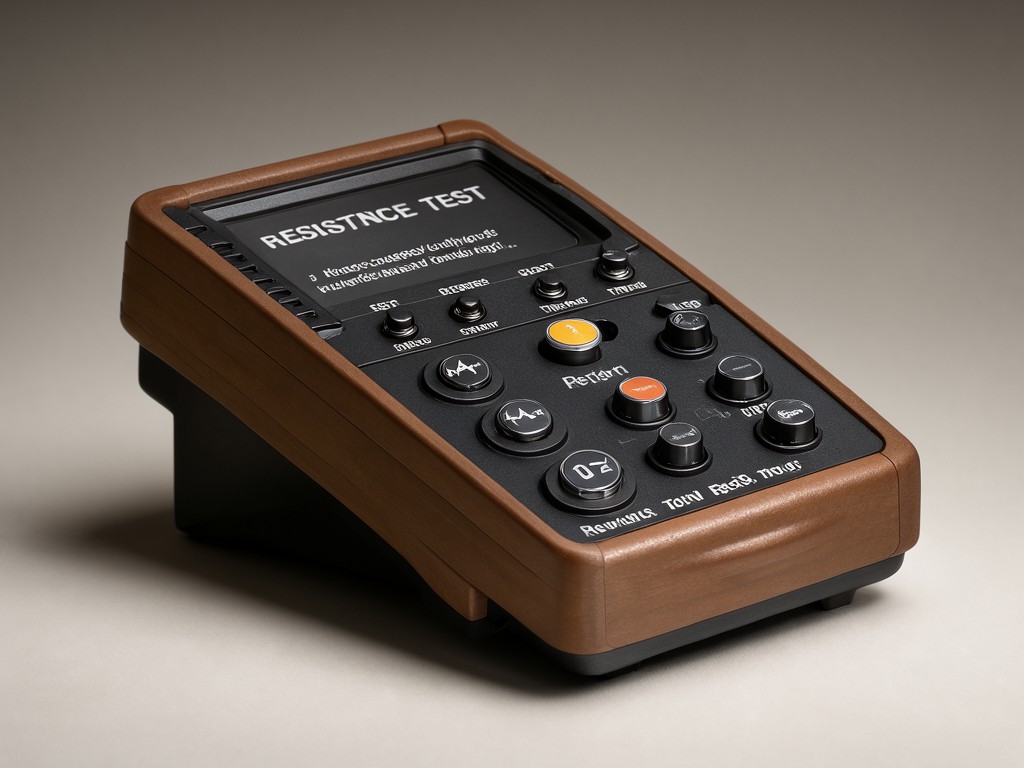
Config A: Lab-Grade Bench (2U Rack)
Target user: Cable QC lab, motor-winding acceptance, connector qualification. Runs 8 h/day, 5 days/week, mostly 1–10 A tests with occasional 100 A pulses for bus-bar verification.
Shunt: Manganin, 4-terminal, oil-bathed in sealed cartridge. Temperature coefficient ±15 ppm/°C, drift <50 ppm/year at 10 A continuous.
Leads: 2 m silicone-jacketed 4-wire harness, gold-plated Kelvin clips (10,000 cycle rated), quick-disconnect DB-15 at instrument.
Calibration interval: 12 months traceable to ISO 17025. Certificate includes 10-point linearity, temperature coefficient, and uncertainty budget (k=2).
Private-label touchpoints: Silk-screen logo on bezel, boot-screen bitmap, units/language defaults, custom pass/fail beep pattern.
Config B: Field Handheld (CAT III 600 V)
Target user: Utility line crew, solar farm commissioning, railway bond testing. One-hand operation, glove-friendly keypad, 3 m drop onto concrete.
Shunt: Evanohm foil, 4-terminal, conformal-coated. Temperature coefficient ±25 ppm/°C, drift <15 ppm/year at 1 A pulsed.
Leads: 3 m TPE-jacketed 4-wire, spring-loaded pistol-grip Kelvin probes (5,000 cycle rated), molded strain relief, captive to instrument.
Calibration interval: 24 months. Certificate includes humidity exposure (95% RH, 40 °C, 96 h) and vibration profile (IEC 60068-2-64).
Private-label touchpoints: Overmolded logo on housing, custom startup screen, pre-loaded test profiles (PV string, rail bond, ground grid), Bluetooth device name.
The decision matrix is simple: if the buyer's end customer measures bus bars, transformer windings, or motor stators in a temperature-controlled lab, Config A pays for itself in calibration longevity. If the end customer climbs poles, crawls under arrays, or walks substation yards, Config B's captive probes and 24-month interval eliminate the "where are my leads?" support calls that eat distributor margin. We do not cross-populate shunts between platforms — the thermal mass and connection geometry are validated per configuration.
What Gets Checked Before Shipment
| Gate | Test / Inspection | Acceptance Criterion | Record Retention |
|---|---|---|---|
| Incoming shunt | 4-wire resistance at 23 °C, TCR sweep 0–50 °C | ±0.01% of nominal, TCR within alloy spec | Lot-linked, 5 years |
| PCBA | ICT + functional: offset, noise, gain error, comms | Offset <0.5 µV, noise <0.2 µVpp, all comms pass | Serial-linked, 7 years |
| Assembly | Hi-pot (1.5 kV AC), insulation resistance (>10 GΩ), ground continuity (<0.1 Ω) | No breakdown, IR >10 GΩ, GC <0.1 Ω | Serial-linked, 7 years |
| Calibration | 10-point per range against 8½-digit reference (traceable) | All points within published accuracy class | Certificate PDF + JSON, 10 years |
| Burn-in | 48 h at 40 °C, cycling max current 30 s on / 30 s off | Zero failures, drift <5 ppm over burn-in | Lot summary, 5 years |
| Final QA | Visual, label/serial match, accessory count, firmware hash | 100% match to packing list, hash verified | Shipment-linked, 7 years |
Every gate is witnessed by a second operator; no self-inspection. The calibration certificate ships in the box and is also uploaded to the buyer's portal (API or SFTP) keyed by serial number. If the private-label agreement requires a co-branded certificate, the template is approved at the pre-production meeting — not at ship date. Buyers who wait until the first container to request certificate format changes add two weeks to lead time.
Export Packaging and Handling Protection
Bench and high-current units ship in double-wall corrugated (ECT 48) with die-cut PE foam inserts that cradle the chassis at four shock-mount points. The foam density (1.9 lb/ft³) is tuned for 30 g half-sine, 11 ms — the ISTA 3A simulated drop profile for 6–15 kg packages. Handheld units use single-wall (ECT 32) with thermoformed PET trays that nest five per master carton; the tray geometry locks the probe tips in recesses so they cannot puncture adjacent units.
Labeling requirement: each master carton carries two barcode labels (Code 128) — one with PO + line item + serial range, one with GS1-128 SSCC for pallet-level tracking. If the importer's WMS requires a specific label layout (e.g., Amazon FBA, Walmart GTIN), provide the spec at order confirmation. Retrofitting labels after the cartons are sealed adds a manual rework step that risks serial-number mismatch.
Desiccant (silica gel, 2 units per bench unit, 1 per handheld) and VCI film are standard for sea freight. Air freight skips VCI but keeps desiccant. Humidity indicator card (3-spot, 10/20/30% RH) is taped inside the outer flap — the receiver can verify exposure without opening the inner pack. Pallets are stretch-wrapped with 80-gauge film, edge boards top and bottom, and strapped with two polyester bands. No wood packaging material (ISPM-15 exempt) — all plywood is replaced by engineered fiberboard to avoid phytosanitary holds at destination ports.
Care, Storage and Service Life
Storage temperature range is −20 °C to +60 °C for all platforms; the handheld Li-ion pack must be cycled (charge to 60%, discharge to 40%) every 6 months if stored >30 days. Bench and high-current units have no battery — only a CR2032 coin cell for RTC, rated 10 years. Conformal coating on all PCBs (acrylic, 25–75 µm) survives condensing humidity; the only uncovered nodes are the shunt terminals and the front-panel BNC/banana jacks, which ship with protective caps installed.
Lead inspection is the single maintenance task that extends calibration interval. Visual check for insulation cuts, probe tip wear (flattened radius >0.3 mm), and strain-relief cracking should be done weekly in high-throughput labs. A 4-wire lead resistance check (short the Kelvin clips, read <1 mΩ) catches internal conductor fractures before they corrupt measurements. We supply a lead-test fixture (PN LTK-01) that plugs into the instrument's self-test port and runs an automated 30-second verification — results log to USB with timestamp and operator ID.
Firmware updates are delivered as signed .bin files via USB or LAN. The bootloader verifies the signature against the OEM public key burned at factory; a mismatched file is rejected and the previous version remains active. No bricked units in five years of field updates. Private-label buyers who maintain their own UI partition can push custom screen layouts without touching the measurement kernel — the partition boundary is enforced by the memory-protection unit (MPU) in the STM32H7 MCU.
Ready to lock the specification?
Send us the target accuracy class, form factor, test-current profile, and private-label artwork requirements. We return a frozen BOM, a calibration certificate template, and a first-article inspection plan within five business days.
Request Specification Review